
Rytr Review 2026: Plans, Limits and the Fine Print
We may earn a commission if you buy through this link. It does not change the price you pay.
An honest look at the plans and the fine print of Rytr, a low-cost AI writing assistant for short copy. The free plan gives 10,000 characters a month; Unlimited costs $9 a month, or $7.50 billed yearly.
Verdict: 3.3 out of 5. Worth a look for short copy in one language on a budget: emails, meta titles, captions, replies to reviews. Skip it if you need team seats or a refund window: subscriptions are non-refundable by default. Writing in more than one language takes the $29 Premium plan.
We may earn a commission if you buy through this link. It does not change the price you pay.
On this page: Features, Pricing, Free plan, Refunds and renewals, Reviews and the FTC case, What changed, Alternatives, Verdict, FAQ, Related.
What Rytr does: use cases, tones and languages
Rytr is a template writer: you pick a use case, add some context, set a tone and a language, and it drafts the copy. The homepage counts 40+ use cases and 20+ preset tones. The menu leans on short formats: email, SEO meta titles, replies to reviews and messages, post and caption ideas, calls to action. Industry pages include ecommerce and small business.
Editing tools sit alongside the templates. Continue Ryting carries on writing for you, an expander “turns one sentence or paragraph into two with rewrites”, and there are tools for rewording, shortening, grammar and free-form commands. Four more features to know:
- My Voice mirrors the tone of a writing sample: no match on Free, one custom tone on Unlimited, several on Premium (five, says the homepage).
- The Chrome extension comes with every plan, Free included.
- Plagiarism checks come with the paid plans only.
- The API is billed separately, by use, with 10,000 free credits to start and no contract.
Two gaps stand out. The plan table has no rows for seats or team features, so ask before buying for a team. And the language count changes from page to page: 1, 1 and 35+ in the plan table, “40+ languages” for Premium on the homepage, “30+ languages” on the API page. On the two cheaper plans you get one language, and the table does not say which.
Rytr pricing 2026: three plans, two ways to pay
There is one free plan and two paid ones. The pricing page opens on yearly billing, with monthly prices one click away.
| Plan | Billed monthly | Billed yearly | AI generation | Plagiarism checks |
|---|---|---|---|---|
| Free | $0 | $0 | 10,000 characters a month | None |
| Unlimited | $9 | $7.50 | Unlimited | 50 a month |
| Premium | $29 | $24.16 | Unlimited | 100 a month |
| Also in the plan table | Free | Unlimited | Premium |
|---|---|---|---|
| Match your own tone of voice | No | 1 tone | Several |
| Languages | 1 | 1 | 35+ |
| Character input limit | Base (no figure) | Doubled | Tripled |
| Custom use cases | No | No | Yes |
| Priority support | No | Yes | Yes |
| Chrome extension and 20+ preset tones | Yes | Yes | Yes |
Read the yearly offer closely. The toggle promises “2 months free”, and the prices match: Unlimited costs $90 a year billed yearly against $108 paid month by month. The FAQ on the same page says the annual plan saves “20% off the total price”, but by the listed prices the saving is about 17%. The FAQ also says a yearly plan “comes with a 12 month commitment”.
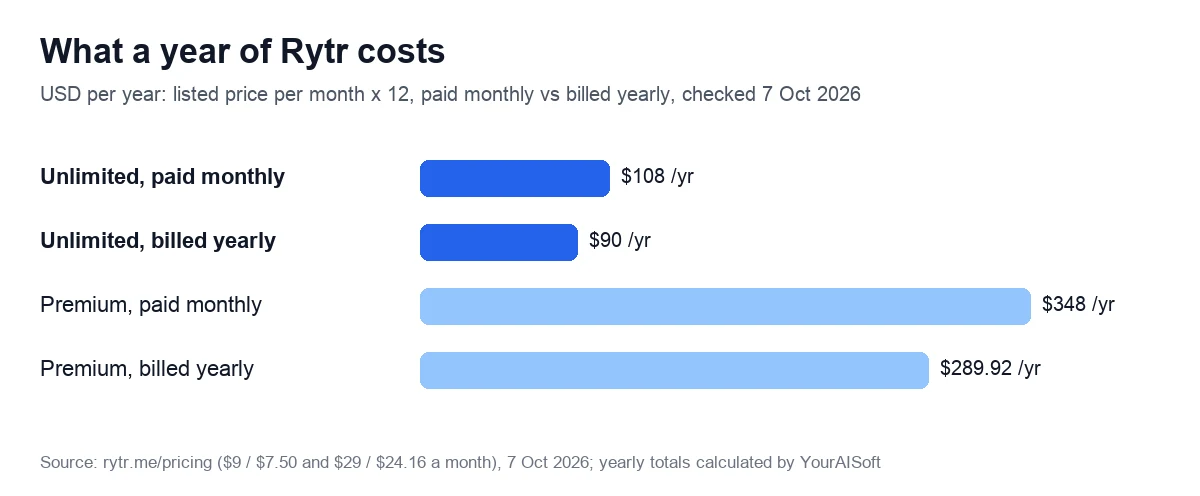
These prices have not moved since at least 27 September 2024, when an archived copy of the page showed the same four figures. If Rytr changes them, the terms promise “reasonable prior notice”, and the new fee starts at the end of your current period. You pay by card; prices are in US dollars, and Stripe, the payment processor, converts other currencies at the time of purchase.
We may earn a commission if you buy through this link. It does not change the price you pay.
Rytr free plan: limits and what is missing
The free plan is permanent, not a trial: the pricing page calls it “Free forever, no CC required”. It gives you 10,000 characters of generation a month, the full use-case library, the preset tones and the Chrome extension.
What it leaves out: plagiarism checks, matching your own tone, priority support, custom use cases and every language but one.
The cap counts characters, not words. At six characters per word, space included, 10,000 characters is about 1,700 words a month, and one 1,000-word blog post would use more than half. That suits emails and captions better than regular blogging.
Looking for a free trial? The pricing page lists none; the free plan plays that role, and the FAQ says you can upgrade later from the credits section of your account.
Refunds, renewals and cancellation
A cheap plan can still cost more than expected. Here is what the Terms of Use and the pricing FAQ say, as read on 7 October 2026.
- Refunds: subscriptions “cannot be refunded as per our Refund Policy”. The company may still grant one case by case, at its “sole discretion”.
- Renewal: plans renew automatically “under the exact same conditions” unless you or the company cancel.
- Monthly plans: you can cancel at any time and keep your remaining credits until the month ends.
- Yearly plans: billed in advance for the full 12-month term.
- How to cancel: the terms describe cancelling renewal by email (address in the Terms), with no refund for the period already paid.
- Trials: none is offered now, but a general clause stays in the terms: a trial that takes card details bills you on its final day unless you cancel.
- Ownership: the FAQ says generated content belongs to the user or the entity using the tool, subject to the terms.
The low-risk route: the free plan, then a month of Unlimited, then a year only if you keep using it.
Ratings, complaints and the FTC case
On 7 October 2026 Rytr had a Trustpilot TrustScore of 4.4 from 2,449 reviews: 90% five-star and 2% one-star, on a profile claimed in April 2021. G2 showed 4.7 from 817 reviews in an archived copy from 6 January 2026. Capterra shows 4.6 from just 18 reviews, the newest shown from October 2023.
Two one-star reviews on Trustpilot are about accounts, not writing:
- 30 June 2026: the reviewer wrote that the company “abandoned customers who purchased lifetime accounts”.
- 15 August 2025: “There is no option to delete your account”, the reviewer wrote, adding that support had not yet replied. The Terms of Use describe no deletion steps; to end your account, they say, you “may simply discontinue using the Service”.
Lifetime access was sold on AppSumo from 13 April to 31 December 2021, at $39 for 50,000 characters a month. That deal is sold out, and the official pricing page has no lifetime plan.
Who is behind it
The terms name Rytr LLC, with a mailing address in Sheridan, Wyoming. In October 2022 Copysmith announced that it had bought Frase and Rytr and launched a group called Copyrytr; our Frase review covers the other product. The company says more than 8 million writers use its tool.
The FTC case, with dates
25 September 2024. In a sweep called Operation AI Comply, the FTC announced a complaint against Rytr; the commission had voted 3–2 to issue it. It alleged that since April 2021 the company had sold a writing assistant with a “Testimonial & Review” use case: “Paid subscribers could generate an unlimited number of detailed consumer reviews based on very limited and generic input”.
The complaint said those reviews carried details unrelated to the input, and some subscribers produced hundreds, in some cases tens of thousands.
18 December 2024. After a public comment period, the FTC approved a final consent order, again by 3–2. It barred the company from advertising, marketing or selling any service “dedicated to – or promoted as – generating consumer reviews or testimonials”.
22 December 2025. The FTC reopened the case and set the order aside by a 2–0 vote. It said it had reviewed the order “in response to President Trump’s AI Action Plan”. It found that the facts in the complaint “fail to support allegations that Rytr violated Section 5 of the FTC Act” and that the order “unduly burdens innovation in the nascent AI industry”. Rytr consented to vacating the order.
The FTC releases do not say what the company changed in its product.
What changed in 2026
Rytr’s price list has stayed the same since at least September 2024. Since late 2025, the changes have come from the legal case and from competitors.
- The FTC’s 2024 order was set aside on 22 December 2025.
- Writesonic rebuilt its plans around tracking brands in AI search; its cheapest plan went from Lite at $49 a month in October 2025 to Starter at $99.
- Copy.ai, described in the deal announcement as a platform “for sales and marketing workflows”, was bought by Fullcast, a revenue-operations software company, on 15 October 2025.
Rytr alternatives: Writesonic, Jasper, Copy.ai
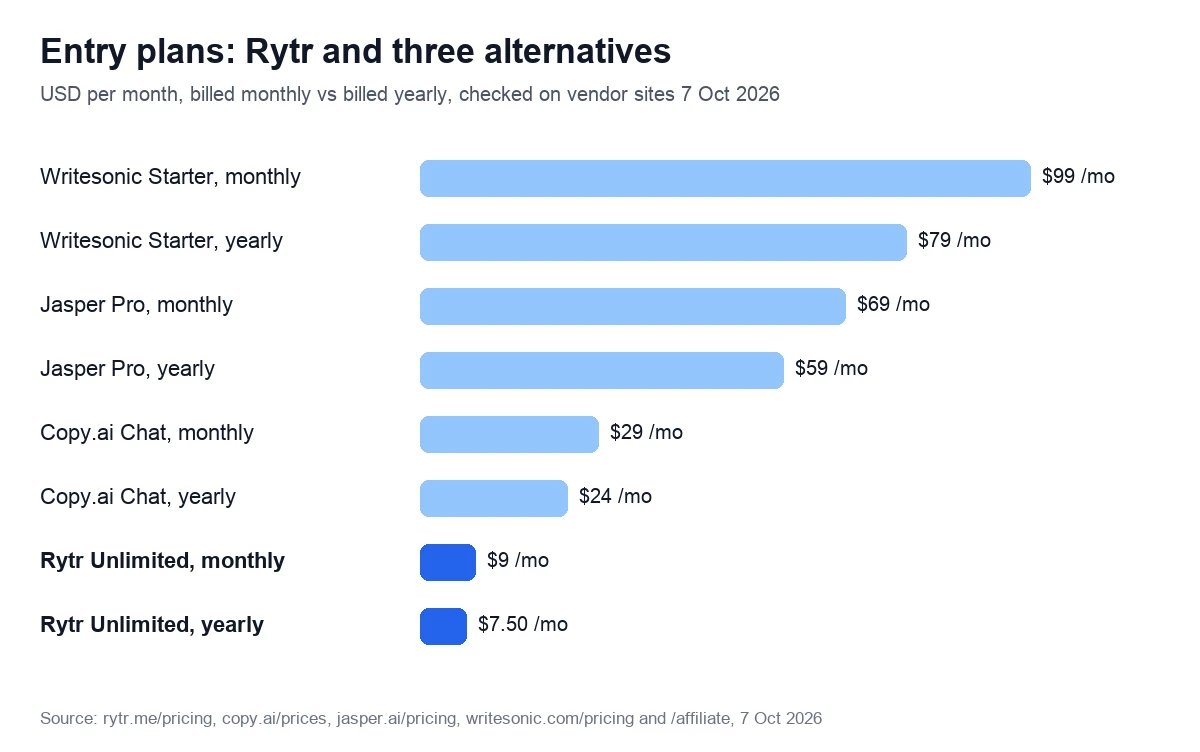
Here are three paid alternatives, with entry plans checked on each vendor’s site on 7 October 2026.
| Tool and plan | Billed monthly | Billed yearly | Free option | Refunds |
|---|---|---|---|---|
| Rytr Unlimited | $9 | $7.50 | Free plan, 10,000 characters | Case by case only |
| Copy.ai Chat | $29 | $24 | None listed | Within 5 days of first purchase |
| Jasper Pro | $69 | $59 | 7-day trial, charged automatically | None on cancellation |
| Writesonic Starter | $99 | $79 | 7-day trial, no card | Within 7 days of first purchase |
Writesonic: for AI search visibility
Writesonic is no longer a like-for-like rival: its plans are built around tracking how ChatGPT, Gemini and Google AI Overviews mention your brand, and Starter adds 15 AI articles a month for one user. There is no free plan, but the trial needs no card, and a first payment can be refunded within 7 days. Our Writesonic pricing breakdown covers the limits.
Start a 7-day Writesonic trial
We may earn a commission if you buy through this link. It does not change the price you pay.
Jasper: on-brand marketing content
Jasper Pro includes 1 seat, 2 brand voices, 5 knowledge assets and 3 audiences. GEO agents and the API need the Business plan, priced on request. Mind the trial: Jasper’s terms say no reminder comes before the trial converts and your card is billed, and “there are no refunds for cancellation”.
Jasper AI vs Rytr: which one to use when
Rytr is for short copy on a small budget; Jasper is for a marketing team that must keep one brand voice across channels. The first difference is price. Rytr Unlimited costs $9 a month, or $7.50 billed yearly, while Jasper Pro costs $69, or $59 billed yearly, for one seat: about eight times as much.
The second is brand control. Jasper Pro stores 2 brand voices, 5 knowledge assets and 3 audiences. The cheaper tool matches 1 tone of your own on Unlimited and several on Premium ($29 a month), which also adds 35+ languages. To test before paying, it has a free plan of 10,000 characters a month with no card, while Jasper offers a 7-day trial. Prices checked on 7 October 2026.
Copy.ai: a chat plan for small teams
Copy.ai Chat covers 5 seats, unlimited words in chat and OpenAI, Anthropic and Gemini models. The next plan, Growth, costs $1,000 a month billed yearly. A full refund is possible only within 5 calendar days of the first purchase.
One assistant for everything
If you would rather pay for one general assistant that also drafts emails and captions, our Gemini vs Claude comparison covers two of them.
Verdict and score: 3.3 out of 5
We score every tool on six weighted criteria, explained on our how we test page. With no account, we do not score output quality; the total is the weighted average of the other five.
| Criterion | Weight | Score | Why |
|---|---|---|---|
| Price for real work | 25% | 4 / 5 | $9 for unlimited generation; more languages need the $29 plan |
| Output quality | 25% | Not scored | No account, no samples generated |
| Limits and fine print | 15% | 3 / 5 | Caps are published; language counts differ between pages |
| Billing and reputation | 15% | 3 / 5 | No refunds by default; Trustpilot 4.4 from 2,449 reviews |
| Support and learning | 10% | 3 / 5 | Help center and community; priority support from Unlimited |
| Maturity of AI features | 10% | 3 / 5 | Core tools on every plan; no seats or team features listed |
| Total | 3.3 / 5 | Weighted average of the five scored criteria |
Who it is for
- Small businesses and solo marketers who write short copy in one language: emails, meta titles, social captions.
- Anyone who wants to try an AI writer on a capped free plan before paying.
- Freelancers writing for several brands, on Premium: several custom tones, 35+ languages and 100 plagiarism checks a month.
Who should skip it
- Teams that need seats or admin controls: the plan table lists none.
- Buyers who want a refund window: Copy.ai offers 5 days and Writesonic 7.
- Marketers tracking brand mentions in AI answers: the product menu has no such tool, so see our best AI SEO tools.
We may earn a commission if you buy through this link. It does not change the price you pay.
How we checked
On 7 October 2026 we read the pricing page (also in a browser), homepage, API page, Terms of Use and archived pricing pages from 2024 and 2025. We also read the FTC releases and case page, the AppSumo listing, the Trustpilot and Capterra pages and an archived G2 page. There are no screenshots from inside the app; affiliate links follow our editorial policy.
Sources: pricing, Terms of Use, pricing in September 2024 (Wayback Machine), FTC complaint announcement, final order and order set aside, Trustpilot, G2 (archived January 2026), Capterra, AppSumo, Copyrytr.
FAQ
Yes, if you write short copy in one language: Unlimited is $9 a month, or $7.50 with yearly billing, less than any other paid plan on this page. Teams, multilingual work below Premium and buyers who want refunds should look elsewhere. We have not scored its writing quality.
Free costs nothing and includes 10,000 characters a month. Unlimited is $9 billed monthly or $7.50 a month billed yearly; Premium is $29, or $24.16 a month billed yearly. Prices are in US dollars, checked on 7 October 2026 and unchanged since at least September 2024. The API is priced separately, by usage.
Not a time-limited one. The pricing page offers a permanent Free plan instead, with no card required and a monthly character cap, but without plagiarism checks or tone matching. The terms still contain a general clause for trials that take card details: you pay on the trial’s final day unless you cancel first.
In September 2024 the FTC alleged that the “Testimonial & Review” use case let paid subscribers generate unlimited detailed reviews from minimal input. A consent order of 18 December 2024 barred the company from selling any service dedicated to, or promoted as, generating reviews or testimonials. The FTC set it aside on 22 December 2025, with the company’s consent.
Usually not. The terms say subscriptions cannot be refunded, though the company may make exceptions at its discretion. A monthly plan can be cancelled at any time, and access lasts until the month ends. A yearly plan is a 12-month commitment, so try the free plan or one paid month first.
Choose by the job. Writesonic now sells AI search visibility: Starter costs $99 a month, or $79 billed yearly, tracks three AI platforms and includes 15 AI articles. Rytr is a template writer for short copy, with a free plan. If AI answers about your brand matter more than daily copy, start with Writesonic.
Price and audience. Jasper Pro costs $69 a month, or $59 billed yearly, for one seat with brand voices and marketing agents. Its trial turns into a paid plan without a reminder, and cancelling brings no refund. Rytr’s paid plans, aimed at individuals and freelancers, cost $9 to $29 a month.
Related reviews
- Writesonic review: AI search tracking plus an article writer.
- Frase review: briefs and an AI writer, bought by Copysmith in the same 2022 deal.
- Gemini vs Claude: two general assistants that also write.
- Best AI SEO tools for Google and AI search.
- All SEO and GEO reviews
- How we test and score AI software