
ElevenLabs Review 2026: Pricing, Free-Plan Limits, Voice Cloning and Who It’s For
As an independent ElevenLabs affiliate, we may earn a commission if you subscribe through this link.
ElevenLabs sells AI voice by credits: one character of text costs one credit, and a minute of speech takes about 1,000 characters. Paid plans start at $6 a month for roughly 30 minutes, with a commercial license.
Verdict: 3.5/5 (output quality not scored). Worth it if you need your own cloned voice, dubbing into 90+ languages or voice agents in one account. Two rules to know first: unused credits expire when you cancel or downgrade, and a refund needs a request within 14 days with no credits used. Narrating slides on a yearly budget? Compare Murf.
Try ElevenLabs free: 10,000 credits a month
As an independent ElevenLabs affiliate, we may earn a commission if you subscribe through this link.
On this page: what you get, pricing, free plan, voice cloning, dubbing and Studio, agents and API, renewals and refunds, trust and reviews, is it worth it, score, FAQ.
What you get: speech, voice cloning, dubbing and agents
ElevenLabs is an AI audio company founded in 2022. It sells three platforms: ElevenCreative for speech, music and video work, ElevenAgents for voice and chat agents, and ElevenAPI for developers. This review is mostly about ElevenCreative, where the ElevenLabs text to speech editor sits next to voice cloning, dubbing, sound effects, music and Studio.
Eleven v3 covers 74 languages, according to the pricing table. Eleven v4, released on 28 September 2026, covers 90+ and works on every plan, the free one included.
Voices come from a shared Voice Library, which the cloning page puts at 17,000+, or from clones and Voice Design voices you create. ElevenReader, the company’s separate read-aloud and audiobook app, is for personal listening: its audio “cannot be exported, distributed, or used commercially”, says the help center.
ElevenLabs pricing in 2026: plans, credits and minutes
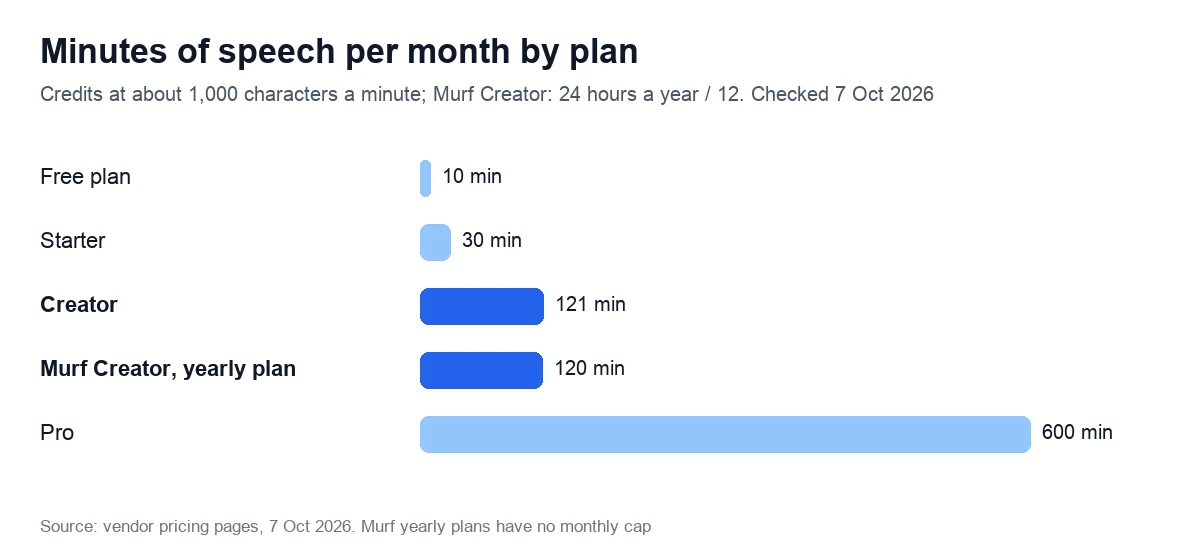
Every ElevenCreative plan comes with one monthly pool of credits that all ElevenCreative products share, so a minute of dubbing or music comes out of the same balance as speech. For speech, the pricing FAQ lists “Text to Speech 1 credit per character”, and the plan table counts about 10 minutes for 10,000 credits, so a minute takes roughly 1,000 characters.
| Plan | Billed monthly | Billed yearly, per month | Credits a month | Speech, about |
|---|---|---|---|---|
| Free | $0 | $0 | 10,000 | 10 min |
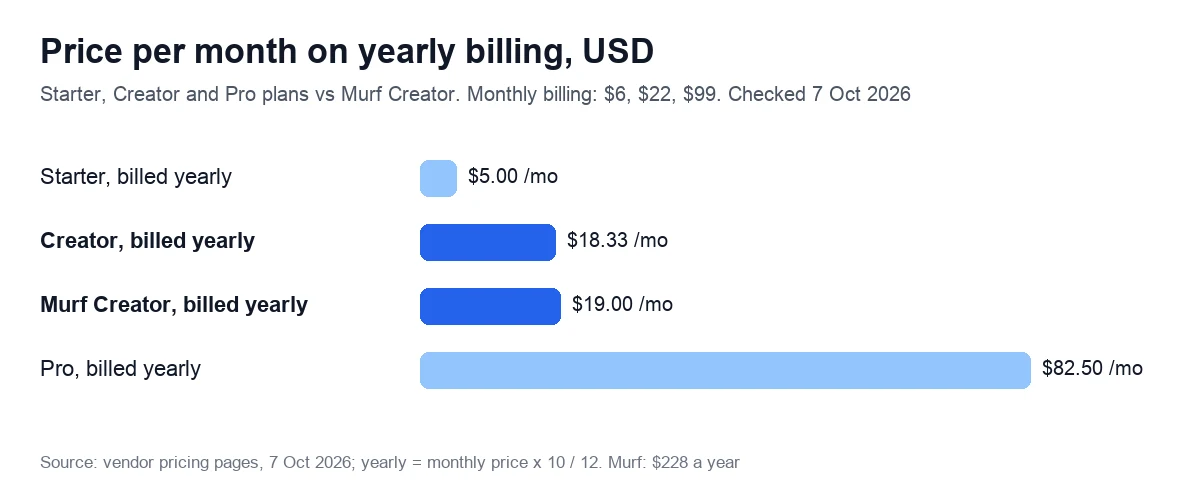
| Starter | $6 | $5 | 30,000 | 30 min |
| Creator | $22 | $18.33 | 121,000 | 121 min |
| Pro | $99 | $82.50 | 600,000 | 600 min |
| Scale, 3 seats | $299 | $249.17 | 1.8 million | 1,800 min |
| Business, 10 seats | $990 | $825 | 6 million | 6,000 min |
| Enterprise | On request | On request | Custom | Custom |
The same comparison table sets the extras below. One discrepancy: a help center article updated on 6 February 2026 lists 15 parallel requests for Business on most models, not 25.
| Plan | Extra minute of speech | Custom voice slots | Professional clones | Parallel requests |
|---|---|---|---|---|
| Free | ~$0.36 | 3 | None | 2 |
| Starter | ~$0.20 | 10 | None | 3 |
| Creator | ~$0.18 | 30 | 1 | 5 |
| Pro | ~$0.17 | 160 | 1 | 10 |
| Scale | ~$0.17 | 660 | 3 | 15 |
| Business | ~$0.17 | 2,200 | 10 | 25 |
Audio comes at 128 kbps on Free and Starter and at up to 192 kbps from Creator, and Pro adds 44.1 kHz PCM output through the API. On the website, one generation takes up to 5,000 characters on paid plans.
Temporary offers in October 2026
On 7 October 2026 the pricing pages also showed the offers below, most with end dates. The help center says “We sometimes offer discounts on the first month of some of our plans”, so check your subscription page before counting on one.
- Starter: the $1 first month (83% off) ran until 18 October; on 21 October 2026 the pricing page showed Starter at the full $6 again.
- Creator: $11 for the first month (50% off), still shown on 21 October 2026 with no end date.
- Eleven v4 launch, Creator and higher plans: v4 speech worth up to 2x your monthly TTS credits doesn’t count against your balance for two weeks, in the web and mobile apps only; the site banner read “3x credits included on Creator+ until October 12”; both launch bonuses ended on 12 October and were gone from the pricing page at our 14 October 2026 check.
- API: v4 at $0.022 instead of $0.08 per 1,000 characters (72% off) until 12 October; on 14 October 2026 the API page listed v4 at $0.08 and v4 Turbo at $0.04 again.
What changed in April and May 2026
Archived copies of the pricing page date the current line-up to 8–15 April 2026. Starter rose from $5 to $6, Creator went from 100,000 to 121,000 credits and Pro from 500,000 to 600,000. Scale fell from $330 to $299 and Business from $1,320 to $990, with 6 million credits instead of 11 million. On 7 May 2026, API text to speech prices dropped by up to 55%.
Is ElevenLabs free? The free plan’s limits in 2026
Yes, within limits. The free plan gives 10,000 credits a month, about 10 minutes of speech, plus 3 Studio projects and the speech to text, sound effects, voice design, music and image tools. Unused credits don’t roll over.
The license is the bigger limit. A help center article updated on 11 August 2026 is explicit: the free plan “does not include a commercial license and cannot be used for any commercial purpose”. Published free-plan audio must credit the source, with “elevenlabs.io” or “11.ai” in the title. Free-plan dubs carry a watermark that can’t be removed.
Free-plan generations stop at 2,500 characters each, and instant voice cloning starts on Starter.
A commercial license starts with Starter at $6. It also outlasts the subscription: “Once your subscription ends, you will still have a commercial license to use whatever you generated during that subscription forever”. Audio made outside a paid period stays non-commercial.
There is no time-limited free trial on the pricing page, only the $0 free plan and, at times, a cheaper first month. University students aged 18+ in the US, Canada, the EU, the UK and Australia get 3 months free under a program announced on 25 September 2026. Startups can apply for 12 months through Startup Grants, and nonprofits and schools can apply to the Impact Program.
See ElevenLabs plans and this month’s offers
As an independent ElevenLabs affiliate, we may earn a commission if you subscribe through this link.
ElevenLabs voice cloning: instant vs professional, and the consent rules
There are two kinds of clone, with different plans and rules.
| Detail | Instant Voice Cloning | Professional Voice Cloning |
|---|---|---|
| First plan | Starter, $6 | Creator, $22 |
| Audio needed | 1–2 minutes, per the docs | 30 minutes minimum, 2–3 hours for best results |
| Ready in | Seconds | About 3–6 hours of training |
| Whose voice | Any voice you have the right and consent to clone | Only your own, confirmed by voice verification |
| Slots | Custom voice slots (10 on Starter) | 1 on Creator and Pro, 3 on Scale, 10 on Business |
For an instant clone, you must “confirm that you have the right and consent to clone the voice”. The professional clone goes further: “You can only create a Professional Voice Clone of your own voice. Even with their consent, you cannot clone someone else’s voice”. Verification asks you to read lines into the microphone, so a company spokesperson has to pass it themselves.
The vendor lists more safeguards: clones of prominent public figures are blocked as “no-go voices”, generated audio can be traced to the account that made it, and an AI Speech Classifier detects the platform’s audio. The prohibited use policy of 17 August 2026 bans impersonating political candidates or elected officials “regardless of whether authorization was obtained”.
Clones speak 32+ languages, per the cloning page, while the professional cloning docs list all 90+ v4 languages. If you drop below Creator, a professional clone stays in the account but can’t be used.
AI dubbing, Studio and audiobooks
ElevenLabs AI dubbing translates a video and re-creates the original speaker’s voice in each target language. The default model, Dubbing v2, covers 90+ languages and charges for every target language. Uploads on the website stop at 2 GB and 180 minutes, and the result can’t be edited: v2 dubs are “completely automatic without any option to edit the content”.
On 7 October 2026 the dubbing page listed about 0.4 minutes of v2 dubbing a month on Free, 2 on Starter, 9 on Creator and 44 on Pro, with extra minutes at $4.91, $2.70, $2.45 and $2.23. Through the API, v2 costs $2.20 a minute.
Two limits to plan around. “At the moment, ElevenLabs does not offer lip syncing as part of Dubbing”, says the help center, which adds that lip sync is available in Image & Video, Flows and Studio via third-party models. And the older Dubbing Studio editor is in maintenance mode, receiving critical bug fixes only.
Studio is the long-form editor for audiobooks, podcasts and narrated video. Version 4.0, announced on 21 September 2026, takes MP4 or MOV uploads and adds voiceovers, music, sound effects and captions. It works on every plan, with 3 projects on Free and 20 on Starter.
Other products spend the same credits: speech to text uses 330 a minute, music 900 a minute and sound effects 200 per generation.
Agents and API: what developers pay
ElevenAgents is billed by call minutes rather than credits. Plans include 15, 75, 275, 1,238, 3,738 and 12,375 minutes a month from Free to Business; extra minutes cost $0.08, and the language model is billed on top. The use policy requires companies to “clearly and prominently disclose to their users they are interacting with AI rather than a human”.
ElevenAPI is billed in dollars: text to speech costs $0.08 per 1,000 characters on v3 and Multilingual v2 and $0.04 on Flash and Turbo. Since 7 May 2026, pay-as-you-go top-ups start at $5 on every self-serve plan. They expire after 12 months and are non-refundable.
Renewals, cancellations and refunds: what to check before paying
These rules come from the terms of service dated 31 March 2026, the pricing FAQ and help center articles, read on 7 October 2026.
- Auto-renewal. Plans renew until cancelled. If prices change, the terms say you must cancel “at least 7 days before the changes take effect” to avoid the new price.
- Cancel before the cycle ends. Cancelling is self-serve from the Subscription page. A cancellation made after the cycle has rolled over applies to the next one: “the system will not cancel the subscription until the end of the new cycle”.
- Unused credits expire when you leave. Credits roll over for up to two months, to at most 3× the monthly quota, while you keep the same paid plan. The pricing FAQ: “Downgrading or cancelling forfeits unused credits at the end of the cycle.”
- Yearly plans still reset monthly. On self-serve plans, credits arrive month by month even when you pay for the year upfront.
- Refunds. The help center: “You are eligible for a refund if a request is filed within 14 days of payment and no credit quota was used in the period for which you are seeking the refund.” Outside the EEA, the terms say fees already paid are not refunded on cancellation; consumers in the EEA, Switzerland and the UK have a 14-day right of withdrawal.
- App store plans. A subscription bought in the mobile app is cancelled and refunded through the App Store or Google Play; deleting your account does not cancel it.
- No pause. “It’s not possible to pause your paid subscription”, says the help center. After cancelling, your content and voices stay in the account.
- Every generation counts. Credits are charged per generation, not per download, with a limited number of free regenerations when the text and settings stay the same.
Can I trust ElevenLabs? Company, data use and reviews
On its own figures, the company is large: a $500 million Series D at an $11 billion valuation in February 2026, an employee share sale at $22 billion announced on 30 September 2026, and over 800 staff. Mati Staniszewski and Piotr Dabkowski founded it. Your contract is with its US company, which gives a New York address in the terms.
By default, some of what you submit helps improve the models. A toggle called “Improve the models for everyone”, under Terms and privacy and then Data use, switches this off for new data. Enterprise data is excluded by default, and Zero Retention Mode covers some Enterprise customers through the API only: “UI traffic is never ZRM-covered”. The vendor states SOC 2 Type II, ISO 27001 and PCI DSS Level 1 certification.
Under the privacy policy of 20 May 2026, data generated about your voice is kept no longer than 3 years after your last interaction, unless the law requires otherwise. The terms give the company a perpetual license to use your content, voice included, to improve its services and develop new ones, with a promise that it “will not commercialize your voice on a standalone basis without your permission”.
On 7 October 2026, Trustpilot showed 3.1 out of 5 from 1,175 reviews: 48% five-star and 38% one-star. The company has claimed the profile since September 2023 and replies to recent reviews, once mentioning a support backlog. Capterra showed 4.7 from 25 reviews the same day.
Complaints in recent one-star reviews:
- Credits after cancelling: one reviewer lost unused credits after unsubscribing (27 September 2026); another had about 100,000 saved credits restored only as short-lived courtesy credits (2 September 2026). Both match the rollover rules above.
- Renewals: a UK reviewer was charged for a yearly plan after trying to downgrade (2 September 2026), and another was told the renewal date can’t be moved by a day (29 September 2026).
- Support and refunds: one reviewer says the automated system and agents only told them to raise a ticket (13 September 2026); another was refused a refund four days after buying because features had been used, then refunded after pointing to the terms and the company’s own policy (31 August 2026).
Praise in recent five-star reviews:
- Voices: natural, expressive delivery for videos, audiobooks and social posts (21 September 2026).
- API and features: a small team in the vendor’s Grants Program calls the API reliable (22 September 2026), and another reviewer says all advertised features work (24 September 2026).
- Support from a person: two reviewers praise thorough help, with a staff member stepping in at key moments (11 September 2026).
Is ElevenLabs worth it? Who it suits, and the alternatives
The ElevenLabs AI voice generator is worth paying for if you need one or more of these in a single account:
- Your own voice, cloned and verified, for courses, ads or a podcast: professional cloning starts at $22 a month.
- Video localization: dubbing into 90+ languages, billed per target language.
- Voice agents for support or sales: call minutes come with every plan, from 15 a month on Free.
Look elsewhere if:
- You need commercial audio for free: the free plan has no commercial license.
- You want to bank unused minutes for months: rollover stops at two months, and credits expire when you cancel.
- You need to edit a dub line by line: v2 dubs can’t be edited, and the editable Dubbing Studio gets critical fixes only.
When Murf fits better
For business narration, Murf is the most direct comparison. Its Creator plan costs $19 a month billed yearly ($228 a year) for 24 hours of voice generation a year, about the same money and minutes as ElevenLabs Creator on yearly billing. Murf’s pricing data gives $29 for monthly billing, a figure we could not see on the page itself. Where they differ:
- Yearly hours: “Yearly plans have no monthly limits, just an overall yearly limit.” ElevenLabs resets credits every month, even on yearly plans.
- Re-renders: in Murf, changing the voice, style, speed or pauses for the same text uses no generation time; ElevenLabs charges per generation.
- Slides: Murf Creator includes the Canva integration, and Business ($66 a month billed yearly) adds PowerPoint.
- Cloning: “Currently, Voice Cloning is available only with our Enterprise plan.” It needs 1–2 hours of studio recordings and the speaker’s explicit written consent.
- Refunds and reviews: refund requests must come within 24 hours of purchase and under 10 minutes of generation; Trustpilot showed 4.6 from 186 reviews on 7 October 2026.
We may earn a commission if you buy through this link. It does not change the price you pay.
Is anything better? That depends on the job. Two former rivals have closed: Play.ht between late December 2025 and early January 2026, and Lovo, whose company filed for Chapter 7 bankruptcy on 27 May 2026, as our Lovo AI review explains. Our alternatives guide, linked at the end of this page, compares other voice tools.
Our score: 3.5 out of 5, and how we checked
We score every tool on six weighted criteria, explained on our How we test page. We have no ElevenLabs account and no audio samples of our own yet, so output quality is not scored; the total is the weighted average of the other five.
| Criterion | Weight | Score | Why |
|---|---|---|---|
| Price for real work | 25% | 4 | About $0.17–0.20 per included minute, Starter to Pro; commercial license on every paid plan |
| Output quality | 25% | Not scored | No account yet |
| Limits and fine print | 15% | 3 | Shared credit pool; credits expire on cancel; vendor pages differ on languages |
| Billing and reputation | 15% | 3 | Public prices, self-serve cancelling; refund only before using credits; Trustpilot 3.1 |
| Support and learning | 10% | 3 | Detailed help center and docs; priority support on Enterprise only |
| Maturity of AI features | 10% | 4 | v4, cloning, dubbing and agents live on self-serve plans; Dubbing Studio in maintenance |
The math: 0.25 × 4 + 0.15 × 3 + 0.15 × 3 + 0.10 × 3 + 0.10 × 4 = 2.60. Divided by 0.75, the total weight of the scored criteria, that gives 3.47, rounded to 3.5. On our scale, 3.0 to 3.9 means good for specific cases: read the limits first.
Sources: the vendor’s pricing, cloning and dubbing pages and 56 help center articles, read on 7 October 2026. We also used the terms (31 March 2026), privacy policy (20 May 2026), use policy (17 August 2026) and pricing-page archives from October 2025 and April 2026. We will re-check prices within 90 days.
The ElevenLabs and Murf links may earn us a commission; the score does not depend on it, as our editorial and transparency policy explains.
Check ElevenLabs pricing for your plan
As an independent ElevenLabs affiliate, we may earn a commission if you subscribe through this link.
Frequently asked questions
On monthly billing, Starter costs $6, Creator $22, Pro $99, Scale $299 and Business $990; the free plan is $0 and Enterprise is priced on request. Yearly billing charges 10 months for 12, so Starter works out to $5 and Creator to $18.33 a month. Prices are in US dollars before tax, listed on 7 October 2026.
Not on the pricing page. The free plan costs $0 a month and gives 10,000 credits a month, about 10 minutes of speech, without a commercial license. Paid plans sometimes start with a cheaper first month, such as Creator at $11 instead of $22 on 21 October 2026, and eligible students, startups and nonprofits can apply for longer free access.
Only as an instant clone, available from Starter, and only after confirming you have the right and the person’s consent. Professional clones, available from Creator, are limited to your own voice and need voice verification. The use policy also bans impersonating political candidates and elected officials, even with their permission.
It depends on the job. Murf suits narration on yearly plans, with a pool of hours and no monthly cap, but clones voices only on Enterprise. Developers can find lower API rates: Murf lists $0.01 to $0.03 per 1,000 characters, against $0.04 (Flash and Turbo) to $0.08 (v3) here. Our alternatives guide, linked below, compares more voice tools.
Yes, on any paid plan, and audio made during a paid subscription keeps its commercial license after you cancel; beta features are excluded, and music has its own limits, such as no streaming on Starter. Free-plan audio can’t be used commercially, and publishing it requires crediting the source in the title.
Yes, for up to two months on paid plans, so a balance can reach three times the monthly quota: 90,000 credits on Starter. Rollover stops when you downgrade or cancel, and the remaining credits expire at the end of the cycle. The free plan has no rollover, and pay-as-you-go credits last 12 months.
Trustpilot is split: 3.1 out of 5 from 1,175 reviews on 7 October 2026, with 48% five-star and 38% one-star ratings. One-star reviews from September 2026 report credits lost after cancelling, renewal charges and trouble reaching support; five-star ones praise natural voices and a reliable API. On G2 we couldn’t open a main listing, so we quote no score there; Capterra showed 4.7 from 25 reviews the same day.
Every paid plan does; the free plan doesn’t. Instant cloning starts on Starter at $6 a month, with 10 custom voice slots. Professional cloning, limited to your own voice, starts on Creator at $22 with one slot; Pro also has one, Scale three and Business ten, while Enterprise sets the number by contract. Figures from the pricing page and help center, checked on 7 October 2026.