
Ahrefs vs Moz Pro in 2026: which to pay for, and when to pick neither
Ahrefs tracks 2.5 times as many keywords on its core plan and claims fresher link data; Moz Pro’s core plan is $30 a month cheaper and includes 150 AI prompts. Both update rankings weekly, and neither promises refunds.
Short answer. Pay for Ahrefs Lite ($129 a month) if you research links or track up to 750 keywords. Pay for Moz Pro Standard ($99, or $79 a month billed yearly in year one) for a small site that also wants AI-answer tracking. Skip both if you need daily rankings included or a card-free trial: see what to buy instead.
Try SE Ranking free for 14 days
We may earn a commission if you buy through this link. It does not change the price you pay.
The 8-point comparison
Prices checked on 7 October 2026, in US dollars, on each vendor’s pricing page. “Core plan” means the first full plan above the Starter tier: Lite on one side, Standard on the other.
| Criterion | Ahrefs | Moz Pro |
|---|---|---|
| Cheapest paid plan | Starter: $29 a month, monthly billing only | Starter: $49 a month |
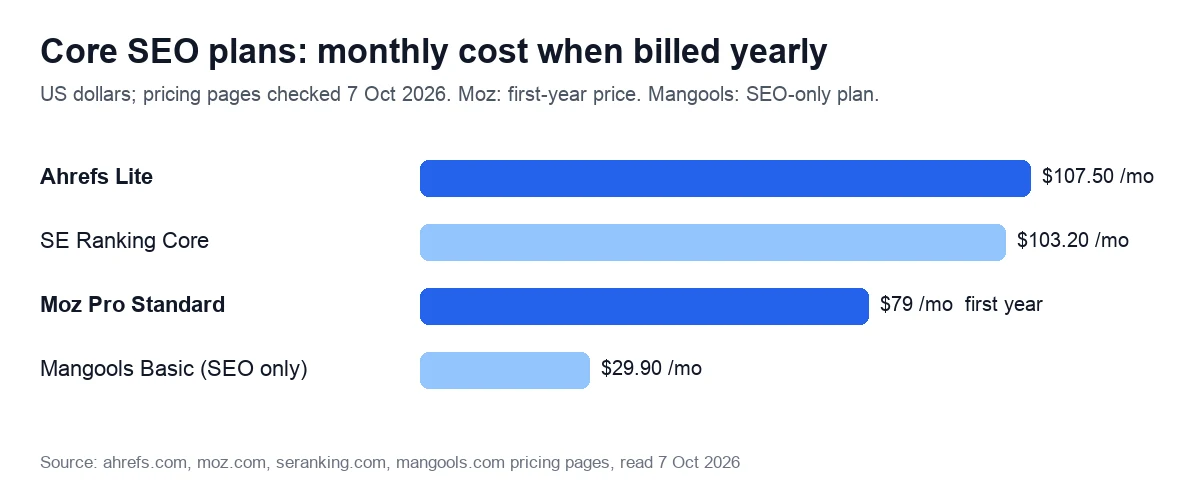
| Core plan | Lite: $129, or $107.50 a month billed yearly | Standard: $99, or $79 a month billed yearly (first year) |
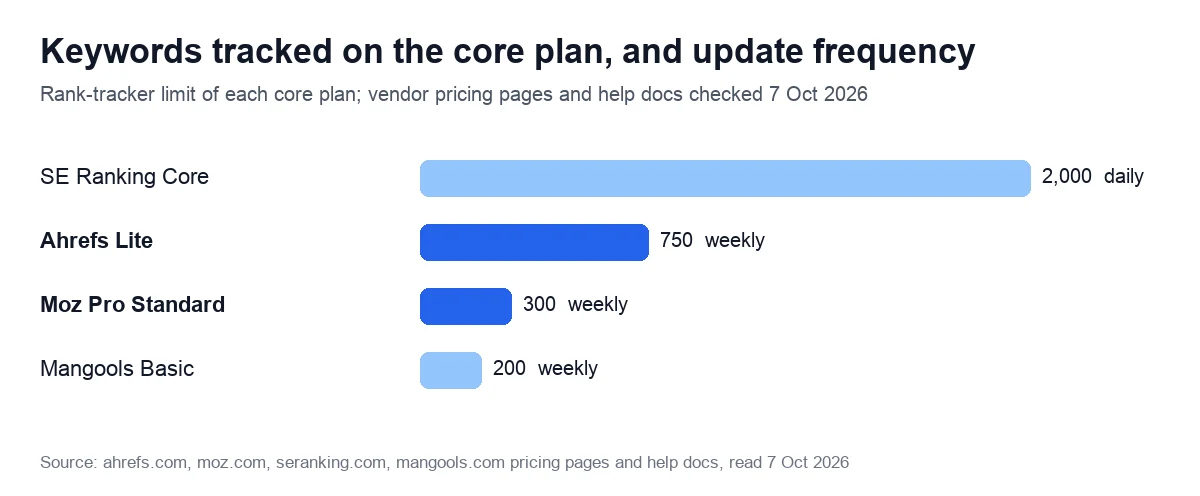
| Keywords tracked on the core plan | 750, updated weekly | 300, updated weekly |
| Site audit on the core plan | 100,000 crawl credits a month | 100,000 pages a week |
| Link index (vendor’s own claim) | 35 trillion link-history records; live index updated every 15–30 minutes | 45.5 trillion links, new ones in about 3 days |
| AI prompts tracked on the core plan | 5, checked daily | 150, checked weekly |
| Trial and refunds | No trial; refunds only in narrow cases | Trial on Medium only; no refunds |
| Trustpilot, 7 October 2026 | 2.2 from 323 reviews | 2.4 from 242 reviews |
Read the table as two trade-offs. Lite buys more tracking capacity and a link index its vendor says refreshes faster. The $99 Standard buys a lower bill, a bigger weekly audit allowance and thirty times as many AI prompts. Neither stands out on trials, refunds or reviews.
Moz DA vs Ahrefs DR: what each score measures
Both scores top out at 100 and both are built from links, so it’s tempting to treat them as one number. They answer different questions.
DR: how strong a link profile is
The DR help article, updated on 3 September 2026, defines it this way: “Domain Rating (DR) shows the strength of a website’s backlink profile compared to the others in our database on a 100-point scale”.
So DR is relative: a site’s score depends on every other site in the same index. The same article says “the source domain splits its rating equally amongst the domains it links to”, so a link from a site that links out to thousands of domains passes very little. It also concedes that DR tracks Google rankings less closely than its URL Rating (UR).
DA: how likely a site is to rank
The DA page in the vendor’s Learn center, last updated on 18 March 2025, says the score “predicts how likely a website is to rank on search engine results pages (SERPs) compared to competitors”. It runs from 1 to 100 and comes from a machine-learning model “primarily focusing on backlink data”. The page is blunt about one limit: “Domain Authority is not a Google ranking factor”.
How to use either score
- Never compare a DR with a DA: each is graded against its own database and formula.
- Compare sites inside one tool, and watch the trend over months rather than a single reading.
- Free checks: a free Moz Community account includes 10 Link Explorer queries a month, and Ahrefs Free opens Site Explorer for sites you verify as your own.
Link index size and freshness
Both vendors publish big numbers, and they count different things.
Ahrefs: 35 trillion history records, live updates every 15–30 minutes
The big-data page lists 35 trillion records of “external backlinks history”, 493.9 billion pages in the index and 28.7 billion keywords. The live index of links is “updated with fresh data every 15–30 minutes”, and DR is calculated from it.
Moz: 45.5 trillion links, new ones in about 3 days
The Link Explorer page claims 45.5 trillion links, 8.7 trillion URLs and 1 billion domains. According to the help center, new links appear “within about 3 days of being found”, and it tries to re-crawl high-quality pages at least every 90 days. Menus on the same help pages say “over 44 trillion” and “over 40 trillion” links, so the published size isn’t consistent.
A history count includes links that have since disappeared, so the two totals aren’t like for like. For outreach or spam monitoring, the claimed refresh speed matters more. We haven’t measured which index finds more live links for a given site.
Pricing in October 2026
Prices checked on 7 October 2026 on each vendor’s pricing page (linked in the column headers), in US dollars. Yearly prices are shown per month.
| Tier | Ahrefs | Moz Pro |
|---|---|---|
| Starter | $29, monthly billing only | $49 |
| Core | Lite: $129, or $107.50 yearly | Standard: $99, or $79 yearly* |
| Middle | Standard: $249, or $207.50 yearly | Medium: $179, or $143 yearly* |
| Top self-serve | Advanced: $449, or $374.17 yearly | Large: $299, or $239 yearly* |
| Enterprise | From $1,499 a month, annual contract | On request |
*The pricing page labels these “billed for your first year” ($950 for Standard) and doesn’t show what the second year costs.
Ahrefs: a year for the price of ten months, extras billed automatically
A yearly plan costs ten monthly payments (“save up to 17%”), but moving an existing plan to yearly billing goes through support. The extras are where the bill grows:
- Extra users cost $40 a month each on Lite (two at most) and $60 on Standard.
- The plan configuration behind the pricing page lists a paid daily-update add-on ($100 a month on Lite, $150 on Standard), but the public page shows weekly updates on every plan and doesn’t advertise it (checked 7 October 2026).
- Once you switch on pay-as-you-go credits, charges run automatically, and accrued usage is billed even after the subscription ends.
- The $29 Starter comes with 200 credits a month, and its terms warn that “features and limits on this plan may be changed without prior notice”.
Moz Pro: 20% off yearly, and per-seat extras
Yearly billing takes 20% off the base plan, and there is no student discount. When we checked, the pricing page also carried a “save up to 40% – ends today!” banner. Other costs to plan for:
- Each extra user is $49 a month, on any plan.
- 200 more tracked keywords cost $20 a month, and each extra campaign (tracked site) is $10.
- The $49 Starter is aimed at “individuals managing a single website”, but the plan comparison on the pricing page covers only Standard, Medium and Large, so its limits aren’t spelled out there.
Rank tracking, audit and research limits
What each core plan lets you track and crawl, Lite at $129 next to Standard at $99:
| Limit | Lite, $129 | Standard, $99 |
|---|---|---|
| Projects or tracked sites | 5 | 3 |
| Tracked keywords | 750 | 300 |
| Rank updates | Weekly; daily add-on not shown on the public page | Weekly |
| Site audit | 100,000 crawl credits a month; up to 25,000 pages per project | 100,000 pages a week (400,000 a month) |
| Research allowance | 1,000 credits per user a month | 150 keyword and 5,000 backlink queries a month |
| Rows per report | 2,500 | Up to 10,000 per backlink query |
| Users included | 1, plus up to 2 at $40 each | 1, plus $49 per extra seat |
| API | Included, with MCP access | Separate product, from $20 a month |
Billed yearly, tracking costs about $14.33 a month per 100 keywords on Lite against $26.33 on Standard. The audit numbers run the other way: Standard crawls its 100,000 pages every week, while Lite’s 100,000 credits have to last a month. Keyword research is the tightest limit on Standard. At 150 queries a month, you get about five a day, and Medium raises the allowance to 5,000.
AI visibility and extra products
Both suites track brand mentions in AI answers, but their core plans include very different amounts.
Ahrefs: 5 prompts on Lite, the rest sold separately
- Lite tracks 5 AI prompts, checked daily. Rank Tracker also flags AI Overviews among 19 SERP features.
- Brand Radar, the AI-visibility product, starts at $199 a month for its AI Visibility Index of 462 million prompts, or $699 a month for all models. Packages for your own prompts start at $50 a month.
- AI Content Helper costs $99 a month for 50 documents.
- Content Explorer, Portfolios and Batch Analysis start on Standard; Lite doesn’t include them.
Moz Pro: 150 prompts on Standard, plus listings and an API
- Standard tracks 150 prompts weekly across four models: GPT, Gemini, Google AI Mode and Perplexity. Medium doubles that to 300.
- It adds AI Overviews by keyword, three AI Visibility dashboards and two AI content briefs a month. Extra prompts cost $50 per 100.
- Listings management is a separate product, from $20 a month per location ($199 billed yearly).
- The API is a separate subscription from $20 a month, with 50 free rows a month.
If AI answers matter more to you than backlinks, a GEO-first platform may fit better; our Writesonic review covers one.
Is Moz legit?
Yes: it’s a real, long-running SEO software company, and the risk is in its billing terms. It was founded in 2004 as SEOmoz by Rand Fishkin and Gillian Muessig, and its footer now reads “SEOMoz, Inc., a Ziff Davis company”. Its What’s new page lists recent additions, such as tripled AI Visibility quotas and an MCP server for the API in beta (the entries are undated).
The Trustpilot score is 2.4 out of 5 from 242 reviews (7 October 2026), with 61% five-star and 28% one-star ratings. At least half of the eight latest one-star reviews (8 June to 21 July 2026) are about billing: a refused refund followed by another charge (21 July), a card charged after a free trial (16 July), a cancellation page called deliberately confusing (8 June). Others cite marketing emails and repeated data outages.
The written terms explain most of those complaints:
- The company “does not offer refunds of any kind”, according to its cancellation help page; cancelling stops the next renewal, not the current period.
- The free trial covers only Medium with monthly billing, needs a card, and converts to a paid subscription automatically. Cancel at least 24 hours before it ends.
- Buying any add-on or upgrading during the trial ends it and starts billing at once.
- Pro and Local renew separately, so cancelling one leaves the other running, and subscriptions can’t be paused.
The rival isn’t rated better. Ahrefs scores 2.2 from 323 reviews, half of them one-star, and its recent complaints are different: accounts restricted for “suspicious activity” (31 May 2026) and traffic estimates far from a site’s own analytics (29 September 2026).
Capterra ratings (7 October 2026) are kinder to both: 4.5 from 350 reviews for Moz Pro and 4.7 from 585 for Ahrefs. Our advice: start monthly and set a reminder two days before any trial end or renewal.
Which one to pick: site owner, local business, agency
Solo site owner or beginner
If you only need data on your own site, start with Ahrefs Free: Site Audit and Site Explorer for verified sites, 5,000 crawl credits a month per project, and no card. For light research on other sites, the $29 Starter is the cheapest paid way into the same data. Moz’s $49 Starter is the alternative for a single website. For rank tracking, compare the two alternatives below.
Small business with a local presence
Moz Pro Standard suits a small business that tracks up to 300 keywords and wants AI-answer tracking in the same bill. Listings cost extra: Moz Local starts at $20 a month per location. To keep local rankings inside one plan instead, SE Ranking Core includes 3 locations and 1,500 local and map keywords for $103.20 a month billed yearly.
Agency or consultant
Ahrefs Standard ($249, or $207.50 a month billed yearly) is pitched at “freelance SEOs and marketing consultants”. It covers 20 projects, 2,000 tracked keywords, Content Explorer, Portfolios and unlimited credits per user. Moz’s Medium ($179, or $143 billed yearly) covers 10 sites, 1,500 keywords and 2 users. Seats add up on both: $60 a month per extra user on that Standard plan, $49 on Medium.
Semrush vs Ahrefs vs Moz: where the third suite fits
Semrush is the usual third option, and it fixes the weekly-rankings problem. Its SEO plan costs $139.95 a month (shown as $139) or $117.33 billed yearly, and it tracks 500 keywords daily across 5 websites. AI-visibility tracking costs extra: $99 a month for the AI Visibility Toolkit, or the $199 Starter plan that bundles it. Adobe completed its purchase of Semrush on 28 April 2026.
The trade-offs: a Trustpilot score of 1.7 from 1,411 reviews, refunds only on a first annual purchase within 7 days, and a 7-day trial that needs a card. Pick it over both if daily rankings matter more to you than price.
Neither? What to buy instead
If the deal-breakers are weekly rankings, no card-free trial and no refunds, two other suites fix part of the problem. SE Ranking Core costs about the same as Lite but tracks 2,000 keywords a day, roughly $5.16 per 100 keywords billed yearly. Mangools Basic is the cheapest core plan on this page. The trade-off is link data: they publish smaller indexes of 2.7 trillion and 9.5 trillion backlinks.
| Plan | Monthly | Billed yearly, per month | Tracked keywords |
|---|---|---|---|
| SE Ranking Core | $129 | $103.20 | 2,000, daily |
| Mangools Basic, SEO only | $49 | $29.90 | 200, weekly |
| Mangools Basic, SEO + AI | $61 | $37.70 | 200, weekly |
SE Ranking Core: daily tracking and a card-free trial
Core tracks 2,000 keywords and 100 AI prompts daily across 10 projects and audits 250,000 pages a month. The 14-day trial needs no card, but payments are non-refundable. The entry price almost doubled in February 2026, when Core at $129 replaced the $65 Essential plan. Two one-star Trustpilot reviews (April and June 2026) say they were migrated to a new plan without consent. The overall score is 4.2 from 712 reviews.
Try SE Ranking free for 14 days
We may earn a commission if you buy through this link. It does not change the price you pay.
Mangools Basic: the cheapest core plan here
Basic costs $29.90 a month billed yearly as an SEO-only plan, or $37.70 with AI Search Watcher, which checks brand mentions in 8 AI systems. It tracks 200 keywords weekly (daily only on Agency) and allows 100 keyword lookups a day, but the bundle has no site-audit tool. Refunds are possible within 48 hours of payment, and the free plan needs no card. Trustpilot: 4.5 from 167 reviews.
We may earn a commission if you buy through this link. It does not change the price you pay.
More picks by budget: our lists of Ahrefs alternatives and Semrush alternatives.
How we compared them
On 7 October 2026 we read each vendor’s pricing page, help-center articles and terms, and logged every figure with a quote, a link and the date. SE Ranking and Mangools showed euros for our location, so part of their dollar pricing comes from archived copies of their pricing pages from 2 and 5 October 2026. Trustpilot scores were read on 7 October.
This page is built from public documents, with no measurements from inside either app, so it makes no claim about whose data is more accurate. Neither suite pays us: Ahrefs has no affiliate program, and we haven’t joined the one Moz runs. The SE Ranking and Mangools links on this page may earn us a commission. More on our process: how we test and our editorial transparency policy.
FAQ
For a small business on a tight budget, Moz Pro: Standard costs $99 a month, or $79 billed yearly in the first year, and includes AI-answer tracking. Ahrefs suits a business that builds links or needs more keywords tracked: Lite costs $129 and covers 2.5 times as many. If daily rankings matter, SE Ranking Core tracks 2,000 keywords a day for $103.20 a month billed yearly.
We haven’t measured either index, so this page doesn’t rank them on accuracy. Each score is graded against its own database: DR rates a link profile against other sites in that index, while DA is a model’s prediction of how likely a site is to rank. Compare sites inside one tool, and treat traffic estimates from any suite as rough.
No. Asked about discounts or free trials, its pricing FAQ answers “We never run discounts” and points site owners to Ahrefs Free instead: Site Explorer and Site Audit for sites you verify, with no card and no time limit. The cheapest paid way in is the $29 Starter plan, billed monthly only, with 200 credits a month and limits that can change without notice.
The length isn’t stated on the pricing page or in the help center. The trial covers only the Medium plan ($179 a month) with monthly billing, needs a credit card and converts to a paid subscription automatically. Cancel at least 24 hours before it ends; buying an add-on or upgrading ends the trial at once and starts billing.
Rarely. Ahrefs “does not issue refunds in general”; on a monthly plan you can ask if you haven’t used the service, but it may refuse after any material activity. Moz “does not offer refunds of any kind”. Of the two alternatives above, Mangools refunds within 48 hours of payment, while SE Ranking payments are non-refundable.
No. Its creator says so directly: “Domain Authority is not a Google ranking factor”. DA predicts how likely a site is to rank, mostly from link data. DR measures link strength rather than predicting rankings, and its own help article says it correlates with rankings less well than URL Rating (UR). Use either to compare sites, not as a target.
Majestic is a link-data specialist: its plans are built around backlink tools such as Site Explorer and Trust Flow. Lite costs $49.99 a month, or $41.67 a month billed yearly, and Lite and Pro come with a 7-day money-back guarantee for new customers, which neither of the two suites compared here offers. Mangools’ LinkMiner also runs on Majestic’s index.