
Perplexity vs ChatGPT in 2026: research with sources vs reasoning, plans and limits
We may earn a commission if you buy through links on this page, at no extra cost to you. The page has one ElevenLabs link, in the voiceover section. As an independent ElevenLabs affiliate, we may earn a commission if you subscribe through this link.
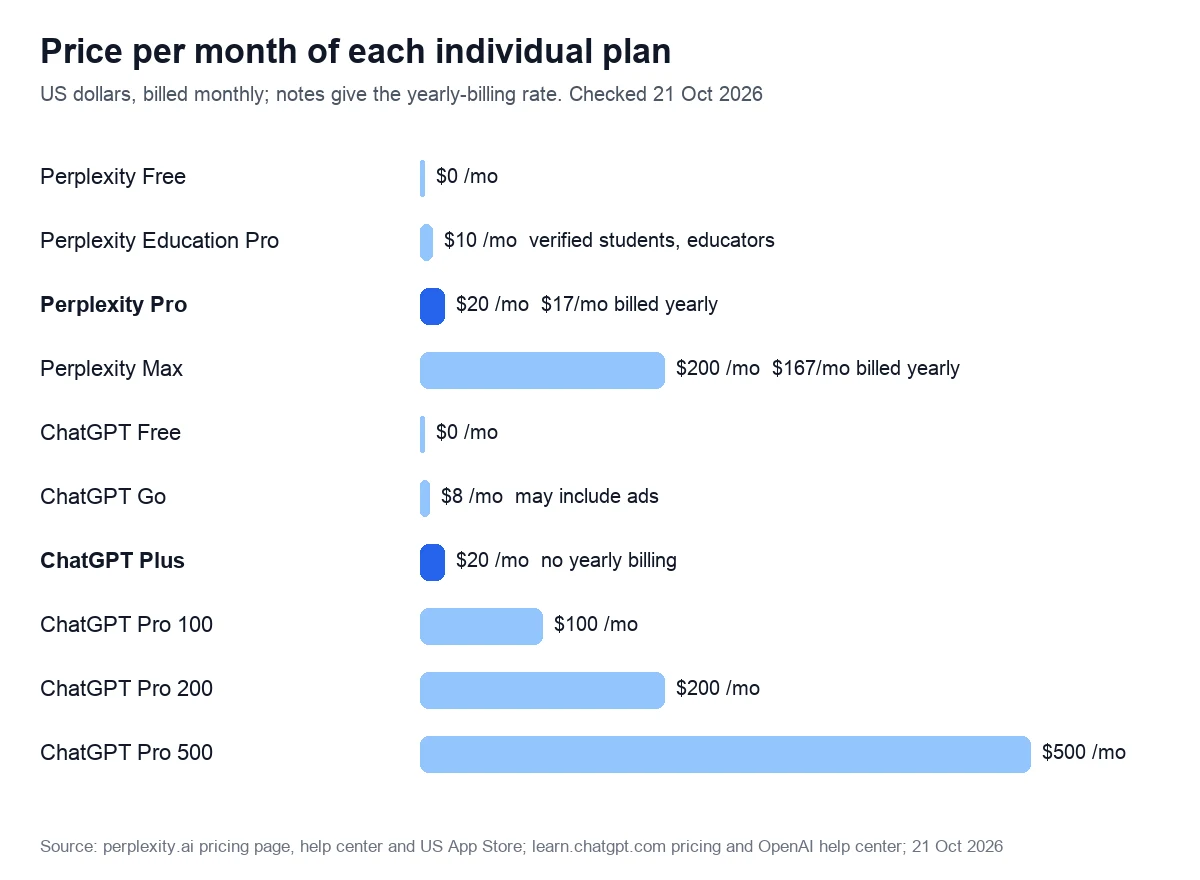
Perplexity AI vs ChatGPT, briefly: Perplexity is a search engine that cites sources in its answers. ChatGPT is a general assistant that can also search. Both main paid plans cost $20 a month (checked 21 October 2026).
Short answer. Pick Perplexity Pro for sourced research: answers link to their sources, and a year costs about $200, against $240 for ChatGPT Plus, which is billed monthly only. Pick Plus for coding, long chats and long documents. Skip Perplexity if you mostly chat. Either way, open the cited pages before you quote them.
See if AI answers cite your site: SE Ranking, 14-day trial
We may earn a commission if you buy through links on this page.
Plans and prices side by side
Prices checked on 21 October 2026, in US dollars before tax, on each company’s pricing page, help center and US App Store listing. The column headers link to the pricing pages.
| Tier | Perplexity | ChatGPT |
|---|---|---|
| Free | $0: basic search, 3 Pro searches a day | $0: unlimited text chats, limited tools |
| Below $20 | Education Pro: $10 for verified students and educators | Go: $8; “This plan may include ads” |
| Main paid plan | Pro: $20 a month, or $17 a month billed yearly | Plus: $20 a month; no yearly billing |
| Heavy use | Max: $200 a month, or $2,000 a year | Pro: $100, $200 or $500 a month |
| Teams, per seat | Enterprise Pro: $40 a month, or $400 a year | Business: $25 a month, or $20 billed yearly |
| Top business tier | Enterprise Max: $325 a month, or $3,250 a year | Enterprise: price on request |
The $20 plans cost the same per month, but only one of them can be billed yearly on the company’s website. OpenAI does “not support annual billing or the option to pay for multiple months in advance” for Go, Plus or Pro, so twelve months of Plus cost $240.
Perplexity’s website shows Pro at $17 a month billed annually, and its help center values twelve months of Pro at $200. Both US App Store listings also show a $200.00 item named after the $20 plan, without naming the period; OpenAI’s help center still says Plus has no yearly billing.
Max’s $2,000 yearly plan is sold on the web only. OpenAI’s Pro comes in three sizes, $100, $200 and $500, all billed monthly. On 29 September 2026 it reopened Pro 200 to new subscribers, with “a lower usage allowance” for those not grandfathered.
Research with sources vs reasoning: how the answers differ
Perplexity calls itself “an AI-powered search engine”. Its pricing page says “Every answer includes inline citations that show exactly where each claim comes from”, and its help center still asks you to “validate information by referencing the sources linked in your answer”. A standard search draws on 1–2 sources and a Pro Search on dozens.
ChatGPT searches the web on every plan, Free included, and gives “cited answers”; with search off, replies rest on what the model learned in training. OpenAI’s help page lists “Fabricated quotes, studies, citations or references to non-existent sources” among possible errors. Its advice is to treat the assistant “as a first draft, not a final source”.
Both tell you to check. The difference is effort: one puts a link next to each claim, the other cites when it searches the web or runs deep research.
For reasoning, OpenAI sells depth. Plus includes “Advanced reasoning models with GPT-6” at the Medium and High thinking levels, and a 256K-token window for reasoning chats. Pro adds Extra High and Pro reasoning on GPT-6 Astra, OpenAI’s “most capable model for complex work across code, apps, and research”.
The search company borrows depth instead. Its Pro plan lets you pick one of seven models per query, among them GPT-6.1 Sol, Claude Sonnet 5.5, Gemini 3.8 Flash and Grok 4.7. Max adds four more, including GPT-6 Astra, Gemini 4 Argon and Claude Opus 5.5 (list of 17 October 2026). Such a model “can behave differently from the same model in the provider’s standalone product”, its help center warns.
LMArena’s Search Arena (24 August 2026, 1.1 million votes) put OpenAI’s gpt-5.6-sol-xhigh first with 1257 points and Perplexity’s in-house Sonar Reasoning Pro 29th with 1139. It ranks models with web search, not the apps, and the search app’s Pro subscribers can pick OpenAI models anyway.
If you publish online. Both assistants now answer with links, yet neither tells a site owner whether its pages are among them. SE Ranking’s AI Search add-on tracks ChatGPT, AI Overviews and AI Mode and includes its sister platform SE Visible, which also covers Perplexity and Gemini. SE Visible alone starts at $99 a month for 200 prompts, or $79 a month billed yearly, with a 10-day trial.
Writesonic’s self-serve plans track ChatGPT but leave Perplexity to Enterprise (all checked 21 October 2026). More in our SE Ranking review, Writesonic review and AI visibility trackers compared.
Track your brand in AI answers with SE Ranking
We may earn a commission if you buy through links on this page.
Usage limits: Pro searches, Research and messages
Neither company publishes a search or chat-message count for its $20 plan. The search engine’s plan table gives Pro “Weekly limits (average use)”, and OpenAI says Plus “may include usage limits such as message caps, especially during high demand”.
| Limit | Perplexity | ChatGPT |
|---|---|---|
| Free plan | 3 Pro searches a day; 1 Research query a month | Unlimited text chats; deep research “Limited” |
| $20 plan | Pro searches: a weekly limit, no number given | Message caps possible “during high demand” |
| Deep research on the $20 plan | Monthly limit, no number; resets on a rolling basis | “Expanded”; the app shows remaining tasks on a counter |
| Top individual plan | Max: weekly limits for “advanced use” | GPT-6 Pro has a weekly limit, even on Pro |
| Published numbers | Enterprise Pro: 400 Pro searches a week, 50 Research a month | Voice: up to 3 hours a day on Plus, 15 on Pro $100 |
| File uploads | Weekly allowance; 40 MB per file; remainder not shown | Free: “Limited”; included on Go, Plus and Pro |
When the free plan stops being enough. Perplexity’s free tier keeps basic searches “practically unlimited” but stops at 3 Pro searches a day, about 21 a week. If most of your questions need cited, multi-source answers, that cap is the reason to pay for Pro. OpenAI’s free plan doesn’t cap plain text chats, so Plus mostly buys reasoning models, higher limits on uploads and tools, and longer memory.
Paid plans have catches too. On Pro $200, once you reach the weekly GPT-6 Pro limit, OpenAI’s app “automatically switches to GPT-5.6 Thinking at Medium”. On the search app’s $20 Pro plan, access to advanced models “may be limited during weeks of especially heavy usage”, its help page warns.
Perplexity Pro: what $20 buys and the weekly Pro-search limit
The plan costs $20 a month in the US App Store, or $17 a month on the website when billed yearly. The help center and pricing page list:
- Pro Search with a weekly allowance instead of the free plan’s 3 a day.
- A model picker per query, plus “premium data sources like PitchBook and Statista”.
- Research reports and “Create files and apps” (DOCX, PDF, XLSX, PPTX and HTML), each with a monthly allowance.
- Image generation, and video clips of up to 8 seconds made with Veo 3.1.
- Up to 50 file uploads per project, at up to 40 MB a file.
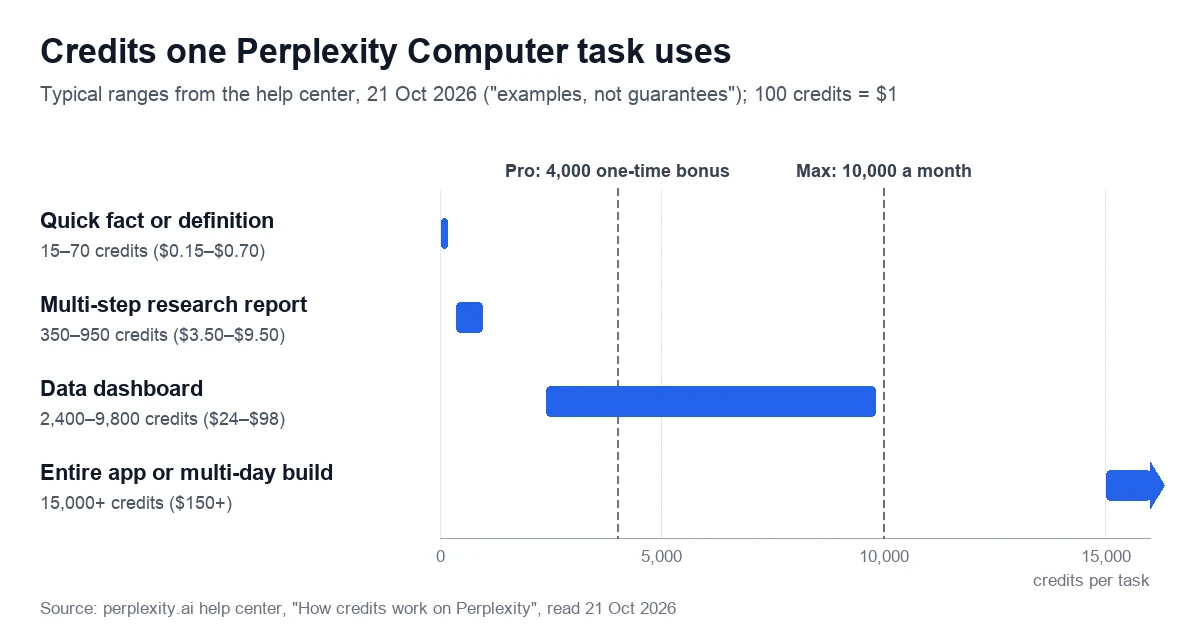
- Computer, described as “Perplexity’s AI assistant that does multi-step work for you”, with a weekly allowance that is “rolling out gradually” and 4,000 one-time bonus credits.
Those bonus credits are worth $40 at 100 credits to the dollar and expire in about 30 days. Ask searches don’t use credits; Computer jobs do, in ranges the help center calls “examples, not guarantees”.
Two things the plan doesn’t promise. The model list is “a snapshot as of October 17, 2026 and is not a commitment to keep any individual model available”. And the pricing page says Pro adds “model council”, while the help center lists Model Council on Max and Enterprise Max only.
Is Perplexity Pro worth it?
It pays off if:
- you need sources you can show a teacher, client or editor;
- you want models from OpenAI, Anthropic, Google and xAI under one subscription;
- you study or teach: Education Pro costs $10 a month after a SheerID check and includes everything in Pro.
It doesn’t if:
- you want long conversations, since the service is “primarily designed for finding and delivering accurate information, rather than engaging in extended conversation”;
- you need a fixed volume, because the weekly Pro numbers aren’t published;
- you need slides or documents in your own template, which it can’t produce yet.
Read the fine print before paying:
- Refunds: 24 hours for monthly and 72 hours for yearly plans, or 14 days in the EU, UK and Turkey and 7 in South Korea and Brazil. The Max article says 48 hours for yearly.
- Promotions and trials need a card and renew “at the standard rate for the plan you selected” unless you cancel first.
- Cancel where you bought it. Deleting the account doesn’t end the subscription, and changing the card through the App Store or Google Play creates “a new, separate subscription”.
- Computer credits are non-refundable, can’t be transferred and expire after a year without using Computer.
ChatGPT Go, Plus and Pro: what each tier adds
- Go, $8: “More messages with tools”, more uploads and image creation, longer memory. It “may include ads”, and deep research stays “Limited”.
- Plus, $20 ($19.99 in the App Store): GPT-6 reasoning, “Expanded deep research”, Codex, the Work agent, Sites and image creation with Thinking. No ads. The card still says “Limits apply”, and API use is billed separately.
- Pro, $100 to $500: Pro reasoning on GPT-6 Astra, “Maximum deep research”, “Unlimited and faster image creation” and Dot, “your always-on agent”, which Pro users in the EEA, Switzerland and the UK don’t get at launch. Only Pro 500 includes Ultrafast.
Some features are gone. The ChatGPT agent “is no longer available”, and Work replaces it. New custom GPTs can’t be created on Free, Go, Plus or Pro.
Past a plan’s allowance, OpenAI sells credits for Codex, Work, Word, Excel and PowerPoint: 100 for $4 in the US App Store, valid for 12 months and non-refundable. Our ChatGPT Plus vs Pro comparison covers the paid tiers in detail, and our Gemini vs Claude guide compares Codex with Google’s and Anthropic’s coding tools.
Comet vs Atlas: OpenAI deprecated its browser in July 2026
Comparisons from early 2026 pit Comet against Atlas, OpenAI’s AI browser. On 9 July 2026, OpenAI announced it was “deprecating Atlas and moving browser-based agentic capabilities into ChatGPT and Codex”. It scheduled Atlas to stop working on 9 August 2026 and said bookmarks, tabs and history would not move over automatically. In July, its help article pointed users to the company’s desktop app, or to its Chrome extension and sidebar where available.
Comet is still available. It’s “a Chromium-based browser” with the company’s search as the default engine, built-in ad blocking and support for “most Chrome extensions”. You can browse and try basic AI features without an account. The agent inside it, Comet Assistant, needs a paid plan:
- Free: no Comet Assistant queries;
- Pro: a monthly allowance, number not published;
- Max: “Max Assistant” and the highest limits on agent queries;
- Enterprise Pro and Enterprise Max: 80 and 800 queries a month.
In Work mode, the assistant runs Computer, so those errands spend credits.
Files, images, video and voice
For documents, OpenAI publishes more detail: Plus takes about 40 pages of text in an Instant chat and about 320 in a reasoning chat. Perplexity caps each file at 40 MB and counts uploads against a weekly allowance it doesn’t display; we found no context-window figure in its help center.
If the report has to become a video. The search app’s paid plans make clips “up to 8 seconds long” with Veo 3.1, and they can’t be edited afterwards. OpenAI has had no video generator since Sora’s web and app versions closed on 26 April 2026.
A narrated explainer of several minutes needs an avatar tool. Synthesia makes presenter videos with 240+ stock avatars or one built from a single photo of you. Its free Basic plan gives 10 minutes of video a month with a watermark. Since 23 September 2026, its MCP connector can create videos “from ChatGPT and Claude” (Synthesia pages, 21 October 2026). More in our Synthesia review and AI avatar generators compared.
See Synthesia’s free and paid plans
We may earn a commission if you buy through links on this page.
If you need a voiceover, not a voice chat. OpenAI’s voice mode “lets you talk through ideas”, for up to 3 hours a day on Plus, and the Perplexity app takes questions by voice. The pages we read describe neither exporting narration as an audio file nor a license to publish it. A narrated report, course or podcast needs a text-to-speech tool.
- ElevenLabs allows commercial use from its $6 Starter plan (21 October 2026): 30,000 credits a month, about 30 minutes of speech, plus instant voice cloning.
- Murf Creator costs $19 a month billed yearly ($228) for 24 hours of voice generation a year, with commercial rights; monthly, it’s $29 for 2 hours a month (prices checked 21 October 2026).
Which one suits which job: our voiceover tools comparison.
Try ElevenLabs free: 10,000 credits a month
As an independent ElevenLabs affiliate, we may earn a commission if you subscribe through this link.
Compare Murf’s Creator and Business plans
We may earn a commission if you buy through this link. It does not change the price you pay.
Privacy, ads, refunds and cancelling
| Topic | Perplexity | ChatGPT |
|---|---|---|
| Your chats and model training | Used to improve the service; opt out with the “AI Data Usage” switch | “Opt-out available”: Settings, Data controls |
| Business plans | Enterprise: “data never used for training” | Business, Enterprise, Edu: not used by default |
| Refund window | 24 h monthly, 72 h yearly; 14 days in EU, UK, Turkey | At OpenAI’s discretion within 7 days, if unused; prorated within 14 days in EU, UK, Turkey |
| Cancelling | Where you bought it; deleting the account doesn’t cancel | Where you bought it; uninstalling the app doesn’t cancel |
A few details matter more than the table shows. OpenAI’s refund policy starts from “Payments are generally non-refundable”, and forgetting to cancel doesn’t qualify by itself. The search company won’t process “secondary refund requests after a first one has been granted”. OpenAI also began testing ads on Free and Go in the US on 9 February 2026; Plus and higher plans have none.
How we compared, and what we didn’t
On 21 October 2026 we read both companies’ pricing pages and help centers, OpenAI’s product docs and both US App Store listings, logging each figure with a quote, a link and the date. OpenAI’s help center and chatgpt.com pricing page returned errors to our tools, so those quotes come from archived copies made between 1 and 19 October 2026, plus a 10 July 2026 copy of the Atlas notice.
Perplexity’s monthly web price didn’t load in our copy of its pricing page; the $20 comes from the App Store and matches its July 2025 Max announcement. SE Ranking, SE Visible and Writesonic figures were re-read on 21 October 2026. We didn’t run prompts or score answers, so this page makes no claim about which assistant writes or reasons better beyond the leaderboard it cites.
Neither company pays us: Perplexity ended its referral programs in late 2025, and we have no deal with OpenAI. The links that may earn us a commission go to voice, video and SEO tools. More on our process: how we test and our editorial transparency policy.
FAQ
For research you have to cite, usually yes. Perplexity says every answer carries inline citations, and Pro Search draws on dozens of sources. ChatGPT cites when it searches or runs deep research, and its reports download as Markdown, Word or PDF. Both help centers tell you to verify important claims before you rely on an answer.
It uses OpenAI’s models, not OpenAI’s app. Pro subscribers can pick GPT-6.1 Sol per query, and Max adds GPT-6 Astra, alongside models from Anthropic, Google and xAI. These run with the search company’s own prompts, tools and limits, so they can behave differently than in OpenAI’s product.
No number is published. The plan table gives Pro “Weekly limits (average use)”, Max weekly limits for “advanced use” and the free plan 3 Pro searches a day. Only the business plans get figures: 400 Pro searches a week on Enterprise Pro and 4,000 on Enterprise Max.
Month to month they cost the same, $20. Over a year, Pro is cheaper: about $200 billed yearly, against $240 for twelve monthly payments of Plus, because OpenAI offers no yearly billing on its personal plans. Verified students and educators pay $10 a month for Education Pro.
One can, briefly. Pro and Max subscribers of the search app get clips of up to 8 seconds from Veo 3.1, possibly with audio, but can’t edit them or buy more. OpenAI’s assistant has had no video generator since Sora’s web and app versions closed on 26 April 2026. For longer presenter videos, an avatar tool fits better.
The browser is: you can install it, then browse and try basic AI features without an account. Its agent, Comet Assistant, is another matter. The free plan gets no assistant queries, Pro a monthly allowance and Max the highest limits, and tasks in Work mode spend Computer credits.
OpenAI announced on 9 July 2026 that it was deprecating Atlas, its AI browser, and moving browser-based agent features into its main app and Codex. Atlas was scheduled to stop working on 9 August 2026. OpenAI said its data would not move over automatically and pointed users to its desktop app or Chrome extension instead.