
ChatGPT Plus vs Pro in 2026: $20 vs $100/$200 tiers, limits and who hits them
We may earn a commission if you buy through links on this page, at no extra cost to you. The page also has one ElevenLabs link, in the voiceover section. As an independent ElevenLabs affiliate, we may earn a commission if you subscribe through this link.
ChatGPT Pro vs Plus, in short: Plus costs $20 a month, and Pro costs $100, $200 or $500 for more usage, Pro-level reasoning and an always-on agent. Every tier bills monthly, and none publishes a fixed message cap.
Short answer. Plus covers daily chat, writing and some deep research. Pro pays off if you run Codex or ChatGPT Work most of the day, need GPT-6 Pro in chat, or talk to Voice over 3 hours a day. Neither plan generates video, and Voice is a conversation, not a voiceover tool: specialist tools cost less than Pro.
Plus and Pro side by side: tiers, models and limits
Prices checked on 21 October 2026, in US dollars, on OpenAI’s Work and Codex pricing page and in the US App Store. Feature rows come from the plan comparison table as archived on 19 October and from help-center articles updated in October.
| Detail | Plus | Pro 100 | Pro 200 | Pro 500 |
|---|---|---|---|---|
| Price, billed monthly only | $20 ($19.99 in the App Store) | $100 | $200 | $500 |
| Thinking levels in chat | Medium, High | Medium to Extra High, plus Pro | Same as Pro 100 | Same as Pro 100 |
| GPT-6 Pro (Astra) in chat | No; Astra only in Work and Codex | Yes | Yes | Not listed by tier |
| Work and Codex windows | Five-hour and weekly | No five-hour window | No five-hour window | No five-hour window, plus Ultrafast |
| Voice a day (GPT-Live-1) | Up to 3 hours | Up to 15 hours | Unlimited | Not listed by tier |
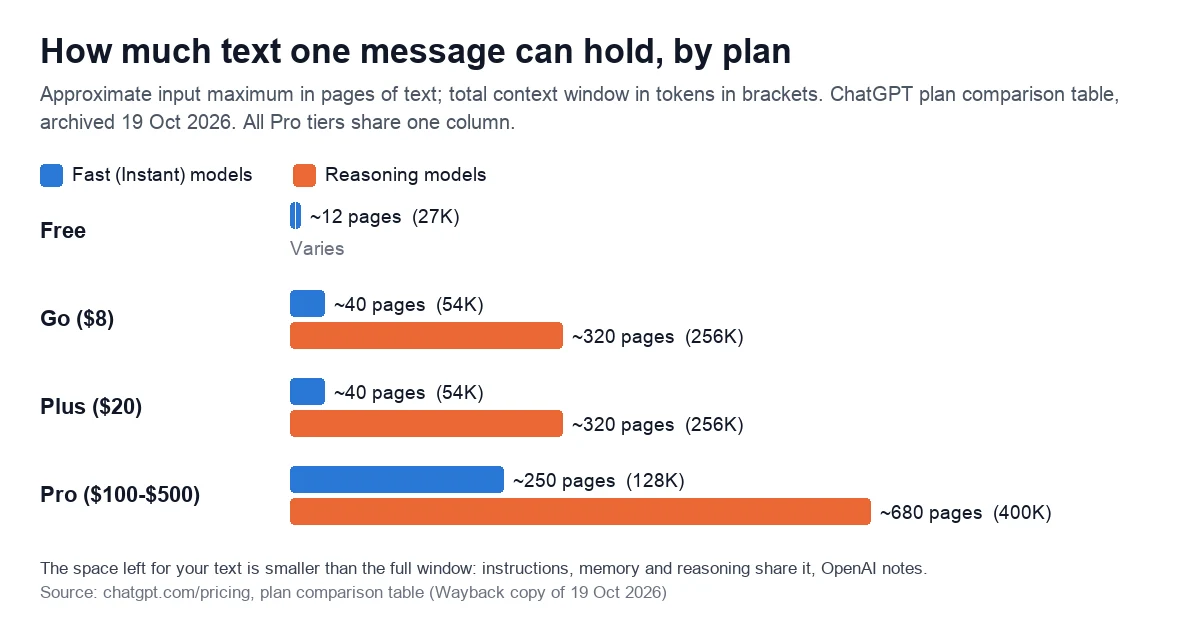
| Context window, fast / reasoning | 54K / 256K tokens | 128K / 400K | 128K / 400K | 128K / 400K |
| Longest input, fast / reasoning | ~40 / ~320 pages | ~250 / ~680 pages | ~250 / ~680 pages | ~250 / ~680 pages |
| Deep research | Expanded | Maximum | Maximum | Maximum |
| Image creation | Yes, with Thinking | Unlimited and faster | Unlimited and faster | Unlimited and faster |
| Dots, always-on agents | No | Yes, outside EEA, UK, Switzerland | Same | Same |
| Space for files and pages | No | Yes | Yes | Yes |
| Training on your chats | Opt-out available | Opt-out available | Opt-out available | Opt-out available |
The pricing page gives the three Pro tiers one feature list. Other OpenAI pages add three splits: Ultrafast only on Pro 500, a 15-hour daily voice cap on Pro 100 (since 9 September), and GPT-6 Pro, which the models article lists for Pro 100 and Pro 200 only.
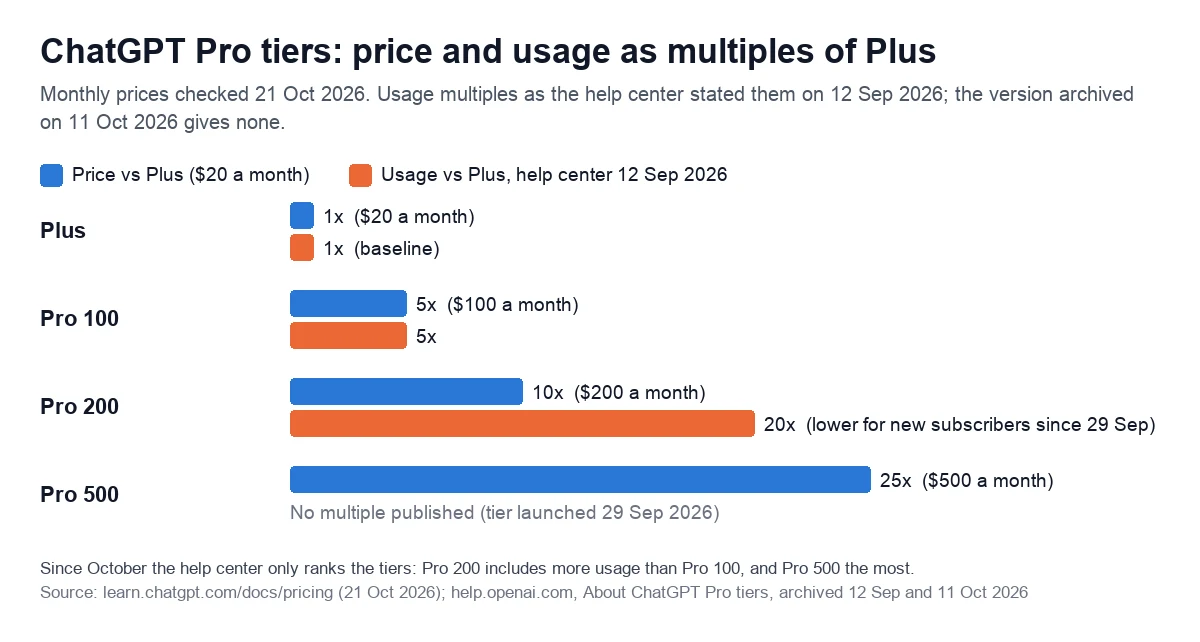
Otherwise the tiers differ in included usage, which the help center (copy of 11 October) only ranks: “Pro 200 includes more usage than Pro 100. Pro 500 offers the highest included usage of the three plans.”
Both plan cards still list custom GPTs, yet the help center says “New GPT creation and publishing are not available on personal ChatGPT accounts”, Plus and Pro included.
Prices and billing: what a year of each tier costs
How much is ChatGPT Plus, then? $20 a month on the web and $19.99 in the US App Store; Pro costs $100, $200 or $500 in both. There is no yearly discount: “Pro is billed monthly. Annual billing and payment for multiple months in advance are not available,” and Go and Plus follow the same rule. Twelve months cost $240 on Plus, $1,200 on Pro 100, $2,400 on Pro 200 and $6,000 on Pro 500.
- Credits. Past the included allowance, Plus and Pro can buy credits for Codex, Work and the Word, Excel and PowerPoint add-ins; 100 credits cost $4 in the App Store. They last 12 months, are non-refundable and “do not add model access”: credits on Pro 100 or Pro 200 don’t unlock Ultrafast.
- Cancelling. Cancel where you paid: ChatGPT, Apple or Google Play. You normally keep the plan until the period ends, and uninstalling the app cancels nothing.
- Teams. Business costs $25 per user a month, or $20 billed yearly, from 2 users, with SSO and no training on workspace data by default.
Usage limits: what OpenAI publishes, and what it doesn’t
Plus has no published message cap for chats. Its help article says Plus “may include usage limits such as message caps, especially during high demand”, and that these “may vary based on system conditions”.
Pro isn’t unlimited either: “GPT-6 Pro has usage limits. A Pro subscription does not include unlimited use of the GPT-6 Pro model.” On Pro 200, reaching the weekly GPT-6 Pro limit switches chats to GPT-5.6 Thinking at Medium. On Pro 100, GPT-6 Pro and GPT-5.6 Sol Pro draw on one weekly allowance, so switching between them buys no extra messages.
Codex and Work share a separate allowance that “does not correspond to a fixed number of messages or tasks”. Plus has a five-hour window and a weekly one; the Pro tiers “currently have no five-hour usage limit” but still have an included allowance. For Plus, OpenAI estimates 5–45 local messages per five hours with GPT-6 Astra, 15–160 with GPT-6.1 Sol and 350–3,000 with GPT-6 Luna, and calls these “estimates, not guaranteed message counts”.
Some settings drain the allowance faster: Fast mode uses it at 2.5 times the Standard rate, Ultrafast on Pro 500 at 8 times, and image generation in Codex about 3–5 times faster than similar turns.
Why the 5x and 20x figures are out of date
On 12 September 2026 the Pro help article said: “Pro $100 unlocks 5x higher usage than Plus, while Pro $200 unlocks 20x usage than Plus.” The version archived on 11 October replaces the multiples with the ranking quoted above.
OpenAI had already paused new Pro 200 sign-ups on 10 September; on 29 September it reopened them with “a lower usage allowance” at the same $200. Subscribers who had Pro 200 at any point from 22 September to 10 a.m. Pacific on 29 September keep the earlier allowance until 29 October 2026.
Who runs into the Plus limits
OpenAI’s Codex page pitches Plus to “Power a few focused coding sessions each week”. Five kinds of use hit a Plus ceiling first:
- All-day coding or agent work. Long Codex or Work sessions with Astra can run into the five-hour window, which Pro doesn’t have.
- Long documents. One Plus message holds about 40 pages of text with fast models and 320 with reasoning ones; Pro takes about 250 and 680.
- The hardest problems. Extra High thinking and GPT-6 Pro in chat are Pro features among personal plans; Plus stops at High.
- Hours of voice chat. Plus allows up to 3 hours of GPT-Live-1 a day, Pro 100 up to 15, Pro 200 no cap.
- Heavy deep research. Quotas aren’t published. A counter in the product shows the tasks left, and fixed monthly allowances reset 30 days after first use. Plus gets “Expanded deep research”, Pro “Maximum deep research”.
If one of these happens most weeks and the work needs ChatGPT itself, Pro 100 is the next step: $80 a month more than Plus, or $960 a year. Benchmarks show a small gap at the top: on Artificial Analysis’s Intelligence Index of 21 October 2026, which tests API models, GPT-6 Astra (max), which powers GPT-6 Pro, scores 53 and GPT-6.1 Sol (max) 52. Plus gets both in Work and Codex.
What Pro adds besides more usage, and what it doesn’t
- Dots. Always-on agents with their own cloud computer, powered by GPT-6 Astra, rolling out gradually to Pro users aged 18 and older. Pro access “excludes the European Economic Area, Switzerland, and the UK at launch”.
- Space and Meetings. Space, which replaces Library for files and shared pages, comes with Pro, Business and Enterprise; the Meetings plugin for meeting notes is in beta on Pro and Business in the macOS app.
- Ultrafast on Pro 500. Faster GPT-6 Astra and GPT-6.1 Sol in Work and Codex, drawing the allowance at 8 times the Standard rate, then credits at 6 times.
Pro does not add:
- Video. No plan generates video since Sora closed (see below).
- Agent mode. “ChatGPT agent is no longer available”; Work takes multi-step tasks. Its old allowance of 400 messages a month on Pro (40 on Plus) is history.
- Yearly billing or admin controls. SSO, admin roles and data residency are marked “No” on both plans; OpenAI sells them with its business plans.
- API access. On either plan, “API usage is separate and billed independently.”
Voiceovers, video and AI visibility: jobs to price outside ChatGPT
If you’re weighing Pro for one of these three jobs, price a specialist tool first. None of the three appears among the features on OpenAI’s plan pages.
Voiceovers: Voice is a chat, not a narration studio
ChatGPT Voice is built for “a live conversation” with a daily cap, and the plan comparison lists no voiceover export, voice cloning or audio licence on any plan. OpenAI’s own text to speech is a separate API product, billed apart from Plus and Pro.
For narration you can publish, two voice platforms have paid plans from $6 and $19 a month (prices as of 21 October 2026):
- ElevenLabs Starter costs $6 a month for 30,000 credits, about 30 minutes of speech in its editor, with a commercial licence and instant voice cloning.
- Murf Creator costs $19 a month billed yearly ($228 for 24 hours of speech a year) or $29 month to month for 2 hours, with commercial rights. Its free plan gives 10 minutes with no downloads and needs no card.
As an independent ElevenLabs affiliate, we may earn a commission if you subscribe through this link.
Try Murf free: 10 minutes, no card
We may earn a commission if you buy through this link. It does not change the price you pay.
Our ElevenLabs vs Murf comparison sets minutes, licences and refunds side by side.
Video: Pro won’t bring Sora back
The Sora web and app experiences “were discontinued on April 26, 2026”, and the Sora API followed on 24 September. On the pricing page, video appears only as “Voice with video”, a camera in voice chats.
For training, product and sales videos with an AI presenter, avatar tools fill the gap. Synthesia’s free Basic plan gives 10 minutes of video a month with a watermark and no card. Starter costs $29 a month, or $18 billed yearly, on the standard price list; US visitors are shown $19 and $14 (pricing page code, 21 October 2026).
See Synthesia’s free and paid plans
We may earn a commission if you buy through links on this page.
Our AI avatar generator comparison prices Synthesia against Colossyan, HeyGen and others per minute of video.
AI visibility: what ChatGPT tells customers about you
A few prompts about your brand in your own account show one set of answers on one day. OpenAI’s help center adds that ChatGPT “can produce incorrect or misleading outputs”, including “fabricated quotes, studies, citations or references to non-existent sources”. AI-visibility trackers run a fixed list of prompts every day and log mentions, links and competitors.
- SE Ranking Core costs $129 a month, or $103.20 billed yearly, and tracks 100 prompts a day in AI answers, ChatGPT included, next to its SEO tools, with a 14-day trial and no card. Its sister product SE Visible, for AI answers only, starts at $99 a month, or $79 billed yearly, for 200 prompts.
- Writesonic Starter costs $79 a month billed yearly, or $99 month to month, for 50 prompts a day across ChatGPT, Gemini and Google AI Overviews, plus AI-written articles.
Start a 14-day SE Ranking trial
We may earn a commission if you buy through links on this page.
Our SE Ranking review, Writesonic review and AI visibility tools comparison cover engines, prompt quotas and trials.
Is ChatGPT Plus worth it?
Plus is worth $20 a month if you use what Free and Go lack: GPT-6 thinking at Medium and High, expanded deep research and Codex usage, ChatGPT Work on the web and mobile, Sites (web pages built from a chat) and an ad-free plan. Go costs $8 and has the same context windows as Plus, 54K and 256K tokens, but it may show ads and keeps deep research and Codex “Limited”.
Buy Plus if:
- you need reasoning or deep research for work several times a week;
- you write code in Codex in a few focused sessions a week;
- you want no ads: Plus and Pro carry none, while Free and Go may.
Stay on Free or Go if you mostly ask everyday questions and draft short texts. Free gives “unlimited everyday text chats, subject to abuse-prevention safeguards”, and Go adds more uploads and image creation for $8.
Skip the upgrade altogether if your real job is narration, video or tracking your brand in AI answers. ElevenLabs starts at $6 a month for voice (see above), Synthesia gives 10 minutes of avatar video a month free, and Writesonic tracks 50 prompts a day from $79 a month billed yearly.
Ratings split by source. On 21 October 2026 the app scored 4.8 from 11 million ratings in the US App Store and 4.8 from 65.4 million reviews on Google Play; on 7 October, chatgpt.com scored 1.6 from 3,763 Trustpilot reviews, 74% of them one-star. None splits reviews by plan.
Anthropic’s Claude tiers cost the same $20, $100 and $200 (checked 7 October 2026); our Claude Pro vs Max guide compares all three vendors, and Gemini vs Claude covers Google’s plans.
What changed in 2026
Dates from OpenAI’s release notes and help center:
- 16 January: Go launched in the US at $8 a month.
- 9 February: ad tests began in the US, on Free and Go only.
- 9 April: a $100 Pro tier joined the $200 one, and Plus Codex usage was rebalanced “to support more sessions across the week”.
- 26 April: Sora’s web and app versions closed.
- 3 September: GPT-6 Astra launched.
- 9 September: daily voice caps set at 3 hours on Plus and 15 on Pro $100, with no cap on Pro $200.
- 10 September: new Pro $200 sign-ups paused.
- 11 September: OpenAI said it plans to retire custom GPTs.
- 29 September: Pro 500 launched with Ultrafast, Pro 200 reopened with a lower allowance for new subscribers, and dots began rolling out.
- 7 October: GPT-6 reached chat; Plus and Pro use GPT-6 Sol, with Pro reasoning on GPT-6 Astra.
- 14 October: the scheduled retirement of GPT-5.5 from chat, Work and Codex.
- 29 October: the earlier Pro 200 allowance ends for grandfathered subscribers.
None of these notes changed the price of Plus.
How we compared the plans
For this ChatGPT Plus vs Pro comparison, on 21 October 2026 we read OpenAI’s Work and Codex pricing page and the App Store and Google Play listings. The ChatGPT pricing page and help center block our scripts, so we used archived copies dated 12 September to 19 October and checked the Wayback Machine for newer ones. Every figure is logged with a quote, link and date.
We haven’t run Plus and Pro side by side, so we don’t measure how far each allowance goes or rate answers. Links to ElevenLabs, Murf, Writesonic, SE Ranking and Synthesia may earn us a commission; links to OpenAI don’t. See how we test and our editorial transparency policy.
FAQ
Not fully. The pricing card says “Unlimited subject to abuse guardrails”, and the models article says GPT-6 Pro has usage limits. Voice is uncapped on Pro 200 but limited to 15 hours a day on Pro 100. Work and Codex have no five-hour window on Pro, though each tier still has an included allowance.
OpenAI publishes no number for chats: its table marks everyday text chats “Unlimited*” (reasonable use), and the Plus article says caps can tighten during high demand. For Codex and Work it gives estimates instead: 5–45 local messages per five hours with GPT-6 Astra on Plus, or 350–3,000 with GPT-6 Luna. Settings → Usage shows the allowance left and the reset times.
No. Go, Plus and Pro are billed monthly only; yearly plans exist for Business and Enterprise. The US App Store lists an in-app item named “ChatGPT Plus” at $200.00 without a billing period, and we couldn’t confirm what it covers. Twelve months of Plus cost $240.
ChatGPT shows when the allowance resets, and you can wait, use another available model or, in Codex, Work and the Office add-ins, spend credits. Eligible Plus and Pro accounts can also buy an instant reset of the Work and Codex windows. Support can’t reset limits for you.
Yes, under Settings → My Plan. Pro 200 subscribers from 22 to 29 September keep their earlier allowance until 29 October 2026, also if they cancel and resubscribe on the same account. After that date, Pro 200 moves to the lower allowance at the same $200, and keeping the old allowance never adds Ultrafast.
Rarely. Payments are “generally non-refundable”; for an unused individual subscription, OpenAI may refund at its discretion if you ask within seven days of the charge. In the EU, UK and Turkey, cancelling within 14 days brings a prorated refund. Apple purchases are refunded by Apple, and a refund normally ends access for that period.