Gemini vs Claude in 2026: $20 plans, usage limits, privacy and coding
Claude vs Gemini is close on price: Google AI Pro costs $19.99 a month, and Anthropic’s Pro plan $20, or $17 a month billed yearly. Both meter use in 5-hour windows under a weekly cap.
Short answer. Both cost about $20 and both include coding tools and a Chrome assistant, so choose by your office suite. Google AI Pro works inside Gmail and Docs and adds 5 TB of storage. Claude Pro works with Microsoft 365 and can be billed yearly. For company data, buy business seats, which stay out of training by default.
Claude vs ChatGPT vs Gemini: the three-way view
ChatGPT Plus, also $20, is the third column. Prices checked on 7 October 2026, in US dollars, on each vendor’s pricing page (linked in the column headers). EU shoppers see euro prices, and VAT may be added at checkout.
| At about $20 | Google AI Pro | Claude Pro | ChatGPT Plus |
|---|---|---|---|
| Monthly price | $19.99 | $20 | $20 |
| Billed yearly | No yearly price listed | $17 a month ($200 up front) | Not offered |
| Included, in short | Gmail, Docs and Vids; 5 TB storage; video generation | Research and Projects; Opus; Microsoft 365 and Chrome | GPT-6 reasoning; custom GPTs; ChatGPT Work |
| Limit wording | “4x higher usage access than Free” | “at least 5x more usage per 5-hour session than Free” | “Limits apply” |
| Models named | 3.1 Pro, 3.6 Flash | Opus, Sonnet, Haiku; Fable via usage credits | GPT-6.1 Sol, GPT-6 Astra, GPT-6 Sol, GPT-6 Luna |
| Context window | 1 million tokens | Up to 1M, varies by model | 54K Instant, 256K reasoning |
| Coding tool | Jules, Antigravity; CLI at 1,500 requests a day | Claude Code, sharing chat limits | Codex, with 5-hour limits |
| Training on chats, and the switch | While Keep Activity is on; switch it off | “Opt-out”; Settings, Privacy | “Opt-out available”; Settings, Data controls |
| Business seat, per user a month | Workspace Business Standard: $14* | Team: $25, or $20 billed yearly | Business: $25, or $20 billed yearly |
*Google sells the assistant to companies through Workspace and through a separate Gemini Enterprise app (page copy of 7 October 2026), which this page doesn’t compare. The price comes from a 12 July 2026 archive of Google’s US pricing page, which didn’t make clear whether it assumes a yearly commitment. Google AI plans themselves need “a personal Google Account that you manage on your own”.
On price the three are a cent apart. Only Anthropic sells its $20 tier by the year; OpenAI does “not support annual billing” for Go, Plus or Pro, and Google’s US page shows no yearly price. Below $20, Google AI Plus costs $4.99 and ChatGPT Go $8, while Anthropic has nothing between Free and Pro.
Free plans compared
- Google, $0: 3.6 Flash with “Varying access to 3.1 Pro”, Deep Research, 15 GB of storage and a 32K-token window.
- Anthropic, $0: chat, web search, file creation, memory, Artifacts and up to 5 projects; no Opus, Research or Claude Code.
- OpenAI, $0: “Unlimited text chats with GPT-5.6 Luna” within abuse guardrails, a 27K window and limited Codex. In January 2026, OpenAI said it would test ads on Free and Go in the US.
Where Copilot and Grok fit
On 1 October 2025, Microsoft launched Microsoft 365 Premium, $19.99 a month in the US with Copilot limits marked “Highest” and 1 TB of storage, and said it would no longer sell Copilot Pro. xAI’s SuperGrok costs $30 a month with Grok 4.6, and SuperGrok Plus $100.
Usage limits, models and context windows
Neither Google nor Anthropic publishes a message count for its $20 plan, and OpenAI’s Plus card says only “Limits apply”.
How each plan meters use
| Rule | Google AI Pro | Claude Pro | ChatGPT Plus |
|---|---|---|---|
| Short window | Refreshes every 5 hours | Rolling 5-hour session | Codex estimates per 5 hours |
| Weekly cap | Yes | Yes, on paid plans | “Weekly limits may also apply” (Codex) |
| Pay to keep going | AI credits | Usage credits at API rates | Extra credits |
| At the limit | Continue on Flash-Lite | Wait, upgrade or use credits | Buy credits or use an API key |
Anthropic’s pricing FAQ says paid plans “add weekly limits on top” of the five-hour window, and that the web, desktop and mobile apps and Claude Code “all draws from the same pool”. The company may also impose “weekly and monthly caps” at its discretion.
Google calls its app limits “compute-based”: they depend on “the complexity of your prompt, the features you use, and the length of your chat”. The 2x and 4x figures on its plans page are “In comparison to non-AI subscribers”, and the help center warns that “Limits may change without notice”.
Anthropic announced weekly limits from 28 August 2025, expecting them to hit “less than 5% of subscribers” (TechCrunch, 28 July 2025), and raised five-hour limits on 22 September 2026. In October 2025, Google still set daily caps, such as 100 prompts of 2.5 Pro a day on AI Pro.
Models listed on 7 October 2026
- Google: the plans page names 3.6 Flash and 3.1 Pro, and Ultra adds the Deep Think mode. The help center’s limits table still says “3 Flash” and “3 Pro”, and the API changelog has listed 3.1 Pro as a Preview since 19 February 2026.
- Anthropic: Fable 5.1 (1 September 2026), Opus 5.5 (22 September), Sonnet 5.5 (28 September) and Haiku 4.5. Opus starts on Pro; Fable costs usage credits on Pro and up to half the weekly limit on Max. Mythos 5.1, the same model with other safeguards, is for trusted-access programs only.
- OpenAI: Plus lists GPT-6.1 Sol, GPT-6 Astra, GPT-6 Sol and GPT-6 Luna; Free runs GPT-5.6 Luna; Pro adds GPT-5.6 Sol Pro. GPT-5.5 leaves ChatGPT on 14 October 2026.
Searches still pit Gemini 2.5 Pro against Claude Opus 4, models that Google’s and Anthropic’s help pages cited in October 2025.
Context windows
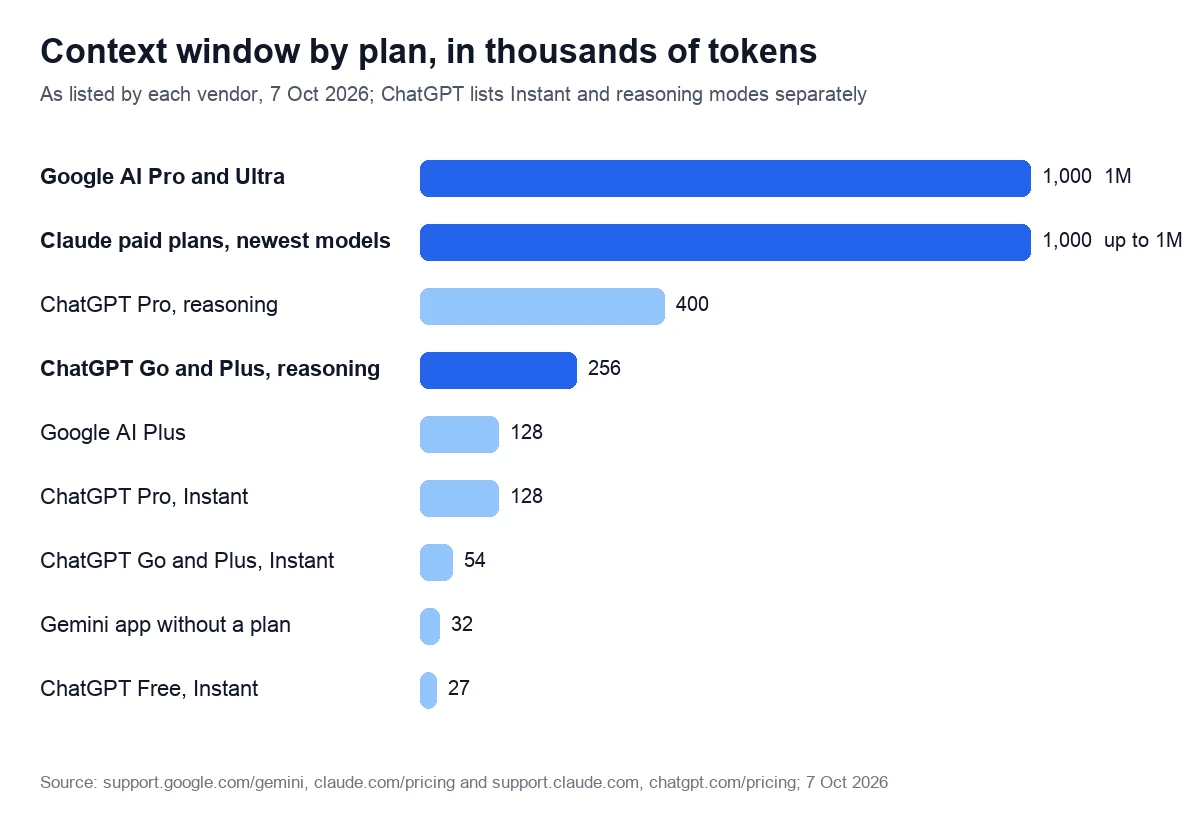
Google gives 32K tokens without a plan, 128K on Plus and 1 million on Pro and Ultra, enough to “Analyze up to 1,500 pages of text”, its plans page says. Anthropic lists “Up to 1M” on every plan; on paid plans, other models get 500K or 200K. OpenAI ranges from 27K on Free to 400K for reasoning on Pro.
The next tier: $100 to $500 a month
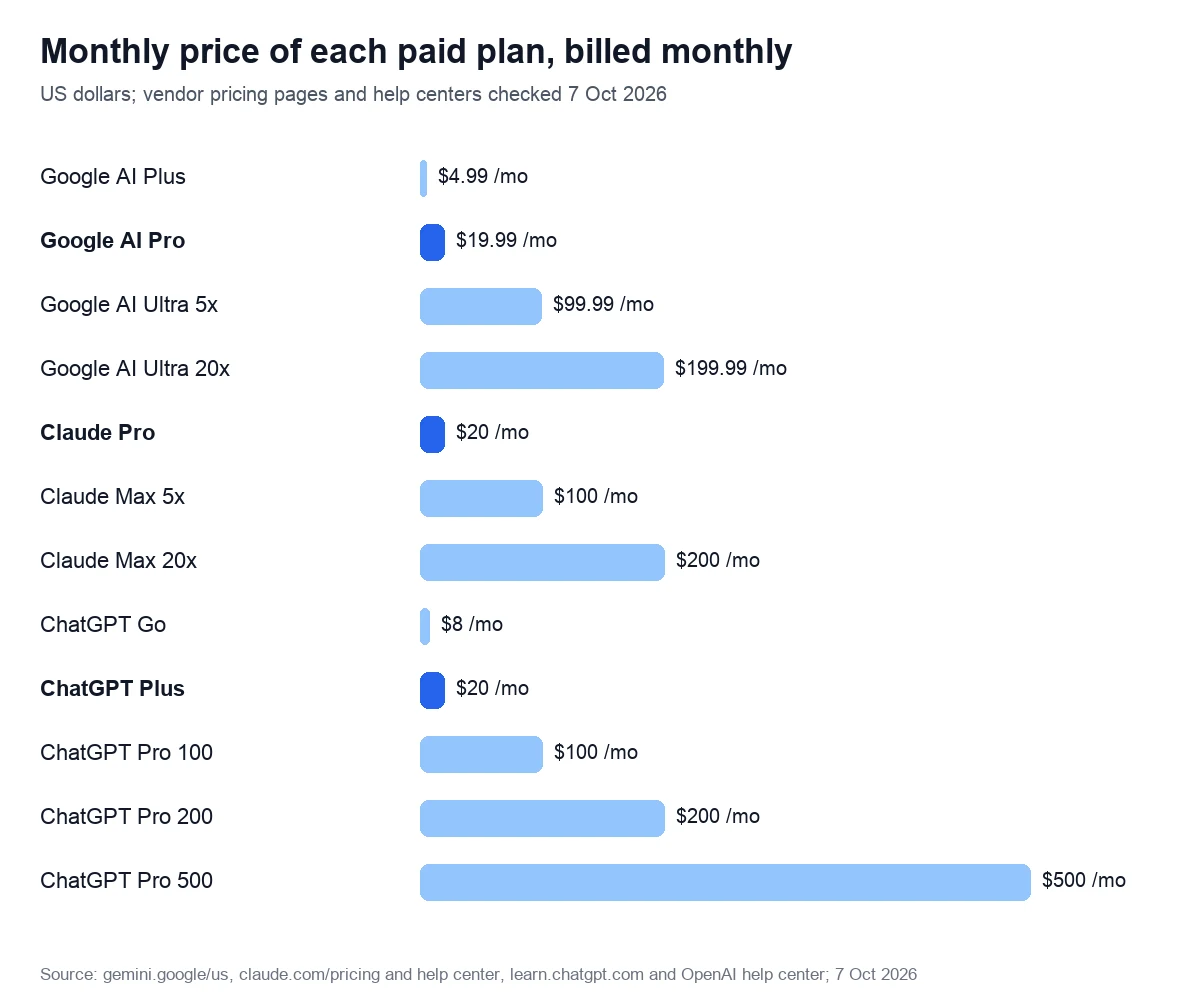
Each vendor sells a heavy-use tier near $100 and another near $200; OpenAI adds a third at $500. None has a yearly price on the pages we checked.
| Plan | Monthly | Usage, per vendor | What’s added |
|---|---|---|---|
| Google AI Ultra 5x | $99.99 | “5x higher usage limits vs. AI Pro” | First access to Deep Think; 20 TB+ storage; “Higher” Antigravity limits; $40/mo Google Cloud credits |
| Google AI Ultra 20x | $199.99 | “20x higher usage limits vs. AI Pro” | “Highest” Antigravity limits; other Ultra extras |
| Max 5x | $100 | 5x Pro “per 5-hour session” | Peak-time priority; Fable up to 50% of weekly limits; $100/mo API credits for your apps |
| Max 20x | $200 | 20x Pro per session | As Max 5x, but with $200/mo API credits |
| ChatGPT Pro 100 | $100 | 5x Plus (help center, 12 September copy) | Codex and ChatGPT Work: “no five-hour limit” for now |
| ChatGPT Pro 200 | $200 | More than Pro 100; new sign-ups get less | Open to new subscribers again (help center, early October) |
| ChatGPT Pro 500 | $500 | “the highest included usage of the three plans” | Astra Ultrafast |
The multipliers don’t compare across vendors: Google’s are relative to AI Pro, Anthropic’s to Pro per 5-hour session, and OpenAI’s to Plus. Google sells Ultra as “the highest level of access”, and Anthropic sells Max “For people who work with Claude all day”. OpenAI says “Choose the Pro plan that fits your usage.”
Each vendor has a catch here. Max is billed monthly only, while Pro can be prepaid for a year. New Pro 200 sign-ups that aren’t grandfathered “include a lower usage allowance”. Some Ultra features are regional: Gemini Agent is “US only, English only”. For Max 5x versus 20x, see our Pro vs Max comparison.
Privacy: what trains on your chats, and how to stop it
On consumer plans, a switch decides whether your chats train the vendor’s models. Each vendor also offers a throwaway mode that isn’t used for training: temporary chats at Google and OpenAI, incognito chats at Anthropic.
Consumer plans
- Google: with Keep Activity on, chats help improve its services, “including training generative AI models”, with help from human reviewers. Reviewed chats are kept up to three years, even if you delete your activity. With it off, new chats aren’t used for training unless you send feedback, but are kept 72 hours, and connected apps such as Google Workspace become unavailable.
- Anthropic: the price table marks model training “Opt-out” on Free, Pro and Max. The privacy center says chats are used if “You choose to allow us to use your chats and coding sessions” or a chat is flagged for safety review. The switch is “Help Improve our AI models” under Settings, Privacy; allowing training extends retention from 30 days to five years. Thumbs-up or thumbs-down feedback keeps the whole conversation up to five years and may be used for training.
- OpenAI: plans for individuals carry “Content is used to train our models: Opt-out available”. The switch is “Improve the model for everyone” under Settings, Data controls. A thumbs-up or thumbs-down can put the whole conversation into training “even if you’ve opted out”.
Business plans
- Google: “Workspace does not use customer data for training models without customer’s prior permission or instruction.” The Workspace assistant holds SOC 1/2/3, ISO/IEC 27001 and 42001 and FedRAMP High, and supports HIPAA workloads; its Notebook and Chrome features aren’t covered yet.
- Anthropic: Team, Enterprise and API content isn’t used for training by default, except feedback you choose to send. Anthropic lists ISO 27001:2022, ISO/IEC 42001:2023 and SOC 2 Type I and II for its business products (privacy center, 16 March 2026); its HIPAA-ready offering, with a BAA, is on Enterprise, and the price table marks it “No” on Team.
- OpenAI: Business, Enterprise, Edu and API content isn’t used by default, and the Business card adds SAML SSO and “No training on your business data by default.” The consumer plans’ table marks SOC 2 and ISO certifications as not included.
For coding: Claude Code, Gemini CLI and Codex
All three $20 plans include a coding tool or a bigger quota for one.
- Google: the open-source Gemini CLI is free with a personal Google account, at 1,000 requests a day; AI Pro raises that to 1,500 and Ultra to 2,000, while Plus doesn’t. AI Pro also raises limits for Jules, an “asynchronous coding agent” in beta, and opens entry-level limits in Antigravity. Code Assist Standard costs $19 per user a month with a yearly commitment, or $22.80 without.
- Anthropic: Claude Code isn’t on Free. On Pro and Max it runs in the terminal and in VS Code, Cursor and JetBrains IDEs, drawing on the same pool as chat. One trap: if an ANTHROPIC_API_KEY environment variable is set, the tool bills that key at API rates instead of using the subscription.
- OpenAI: Codex comes with every plan, from “quick coding tasks” on Free to “a few focused coding sessions each week” on Plus, in the web app, CLI, IDE extension and iOS. OpenAI estimates 15–160 messages per 5 hours with GPT-6.1 Sol on Plus; Pro has “no five-hour limit” for now.
If you code in an IDE and want models from more than one vendor, GitHub Copilot Pro costs $10 a month. Its plan docs list models from Anthropic, Google and OpenAI, such as Opus 5.5, 3.8 Flash and GPT-6.1 Sol; Pro gets “a selection of models”, Pro+ and Max premium ones.
For a team: price per seat
For two or more people, the vendors’ business plans replace the consumer tiers.
| Plan | Price per user a month | Billing | Team size |
|---|---|---|---|
| Workspace Business Starter (Google) | $7* | Not confirmed* | Up to 300 |
| Workspace Business Standard (Google) | $14* | Not confirmed* | Up to 300 |
| Workspace Business Plus (Google) | $22* | Not confirmed* | Up to 300 |
| Team, standard seat (Anthropic) | $25, or $20 | Monthly, or yearly | 2 to 150 |
| Team, premium seat (Anthropic) | $125, or $100 | Monthly, or yearly | 2 to 150 |
| Enterprise (Anthropic) | $20 plus usage at API rates | Yearly only | Not stated |
| Business (OpenAI) | $25, or $20 | Monthly, or yearly | 2 or more |
*From the same July 2026 archive of the US pricing page, where a toggle read “Save 16% with 1 year commitment”.
On list price, Google’s Starter and Standard seats cost the least, and they come with business email, storage and video meetings. Starter puts the assistant only in Gmail and the Gemini app; Docs, Meet and the other apps start at Business Standard. Anthropic’s premium seat gives “5x more usage than standard seats” for five times the price.
Anthropic and OpenAI made the same cut. In October 2025 both charged $30 a seat monthly or $25 yearly; both have since cut $5 from each price, and both start at 2 seats (Anthropic’s minimum used to be 5).
Which one fits your job
- SEO and content: neither plan lists rank tracking or monitoring of brand mentions in AI answers. Compare AI SEO tools and AI visibility trackers for that.
- Video: Google AI Pro includes video generation, 1,000 Flow credits and a limited trial of Veo 3.1 Lite; Anthropic’s plan list doesn’t mention video. For presenter videos, see AI avatar generators; for editing, AI video editors.
- Voiceovers: for narration with per-plan minutes and voice cloning, see our ElevenLabs review and Murf AI review.
- Music: Google lists music generation among its assistant’s features; licensing rules for business use are compared in our guide to AI music generators.
What customers say
We read the Trustpilot profiles on 7 October 2026. All five scored between 1.3 and 1.6 out of 5, and none is claimed by its company.
| Trustpilot profile | TrustScore | Reviews | 1-star share |
|---|---|---|---|
| claude.ai | 1.5 | 2,034 | 80% |
| anthropic.com | 1.3 | 501 | 88% |
| gemini.google.com | 1.4 | 1,314 | 81% |
| chatgpt.com | 1.6 | 3,763 | 74% |
| openai.com | 1.3 | 1,231 | 84% |
The newest reviews we saw were about usage limits (on the Claude and ChatGPT profiles, 6 October) and features moving behind a subscription (on the Gemini profile, 4 October).
How we compared, and what we didn’t
On 7 October 2026 we read each vendor’s pricing, help and privacy pages and logged every figure with a quote, a link and the date. Our browser saw euro prices, so dollar figures come from US pages and vendor docs. Some OpenAI help and pricing pages and the Workspace prices come from archived copies made between 12 July and 5 October 2026; older figures carry their own dates.
We didn’t run prompts, time answers or score them, so this page makes no claim about which assistant writes, reasons or codes better. Model descriptions in the FAQ are the vendors’ own, with dates.
None of the assistant vendors compared here pays us, and this page has no affiliate links. Every statement about Google, Anthropic and OpenAI needed the same kind of dated source.
Not covered: answer quality, speed, regional availability, the Gemini Enterprise app and Microsoft’s Copilot price for companies. More on our process: how we test and our editorial transparency policy.
FAQ
On list price, Google’s seats are cheaper. A 12 July 2026 copy of Google’s US page listed Workspace Business Standard at $14 per user a month, billing cycle not confirmed, with email, storage and meetings included. Anthropic’s Team standard seat costs $25 a month, or $20 billed yearly, for 2 to 150 people, the same as ChatGPT Business.
On consumer plans, a setting decides. Google trains on chats while Keep Activity is on, and human reviewers read some. Anthropic’s price table lists training as “Opt-out”; its privacy center says chats are used if you allow it or if they’re flagged for safety review. Workspace, Anthropic’s Team and Enterprise, and ChatGPT Business don’t train on your content by default.
Google’s privacy hub, updated 24 September 2026, spells out what happens. While Keep Activity is on, your chats can train its models, some go to human reviewers, and reviewed chats are retained up to three years. Google says chats aren’t used to show you ads. With Keep Activity off, new chats aren’t used for training unless you send feedback, but stay stored for 72 hours.
We don’t measure answer quality, so we can’t rank them. Each vendor describes its own top model: Google calls 3.1 Pro one of its “most capable models” (plans page, 7 October 2026), and Anthropic recommends Fable 5.1 “for demanding reasoning and long-horizon agentic work” (model docs, 7 October 2026). Documented specs are close: both offer 1M-token windows and tiers at about $20 and $200.
Yes: Google, Anthropic and OpenAI all have $0 plans, with fewer features. Google’s free tier has a 32K-token window and “Standard limits”. Anthropic’s includes web search, memory, Artifacts and up to 5 projects, without Opus or Research. OpenAI’s gives a 27K window on its Instant model. For code, Google’s CLI is free at 1,000 requests a day with a personal account.
All three $20 plans do. Anthropic’s Pro and Max include Claude Code, which shares one usage pool with chat. Google AI Pro raises the free CLI quota to 1,500 requests a day and adds Jules and Antigravity limits. ChatGPT Plus includes Codex. Only Anthropic leaves its tool off the free plan.
Google AI Pro puts the assistant in Gmail, Docs and Vids; Workspace business plans add it to Docs and Meet from Business Standard up. Anthropic lists Microsoft 365 and Chrome versions among Pro features, and Google AI Pro has its own Chrome feature. Google’s consumer plans don’t mention Microsoft 365, but its Gemini Enterprise business edition lists Microsoft 365 connectors (page copy of 7 October 2026).