
Midjourney Alternatives 2026: 8 Image Generators Compared on Price, Free Plans and Commercial Rights
Midjourney offers no free trial on its website or in Discord, and its cheapest plan costs $10 a month. We compared eight alternatives on entry price, free plans, commercial rights and image privacy, with prices checked on 21 October 2026.
Quick verdict: Leonardo AI is the like-for-like swap: plans at $12, $30 and $60, 150 free tokens a day and private images from $12; Midjourney hides images only from $60. Krea is a low-cost way to try many models: $9 a month, or about $5 billed yearly. Skip Krea’s free plan for client work: it has no commercial license.
We may earn a commission if you buy through links on this page.
Why people look elsewhere: Midjourney’s pricing and the missing free trial
The service runs on its website and on a Discord server, and all four plans renew automatically until you cancel. So, how much is Midjourney? Between $10 and $120 a month:
Prices checked on 21 October 2026, in US dollars. The help center blocks automated requests, so these figures come from a copy of its plan comparison saved on 15 October 2026.
| Plan | Monthly | Billed yearly | Fast GPU time a month | Unlimited Relax mode |
|---|---|---|---|---|
| Basic | $10 | $96 ($8 a month) | 3.3 hours (200 minutes) | No |
| Standard | $30 | $288 ($24 a month) | 15 hours | Images |
| Pro | $60 | $576 ($48 a month) | 30 hours | Images and SD video |
| Mega | $120 | $1,152 ($96 a month) | 60 hours | Images and SD video |
Extra fast time costs $4 an hour on every plan. Yearly billing saves 20%, but the whole year is paid upfront. Basic has no Relax mode, which Standard and higher plans use for unlimited image generation.
Reasons to look elsewhere:
- No free trial. The help center states: “No free trial is currently available in Discord or the midjourney.com website.” A limited trial exists only in the niji·journey app for iOS and Android.
- Few refunds. You qualify only if the account has used less than 20 GPU minutes in its lifetime, counting Fast, Turbo and Relax time together, per a help-center copy saved in March 2026.
- Public by default. The terms say your content is “publicly viewable and remixable”. Stealth Mode hides it only on Pro and Mega, from $48 a month billed yearly, and anything made in a shared Discord room stays visible to that room. For private images from $12, see the comparison below.
- A revenue rule. Any subscriber may use images and videos commercially, but a company with more than $1,000,000 in gross yearly revenue must buy Pro or Mega.
- Open lawsuits. Disney and Universal sued the company on 11 June 2025, and Warner Bros. Discovery followed on 4 September 2025. In July 2026, TechCrunch described the dispute with the three studios as ongoing. If that risk matters for client work, see the commercial-safety pick below.
- A weak review score. Trustpilot showed 1.7 out of 5 from 373 reviews on 21 October 2026, with 76% one-star. Recent reviews there describe distorted images and an account blocked after renewal.
On the product side, the changelog shows steady updates. V8.1 became the default model on 11 June 2026, and the company says it follows detailed prompts and renders text “better than ever”. V8.2 arrived on 24 July 2026 with a focus on aesthetics. Video has existed since June 2025, but only as image-to-video, and unlimited Relax video needs Pro or Mega.
Eight alternatives side by side
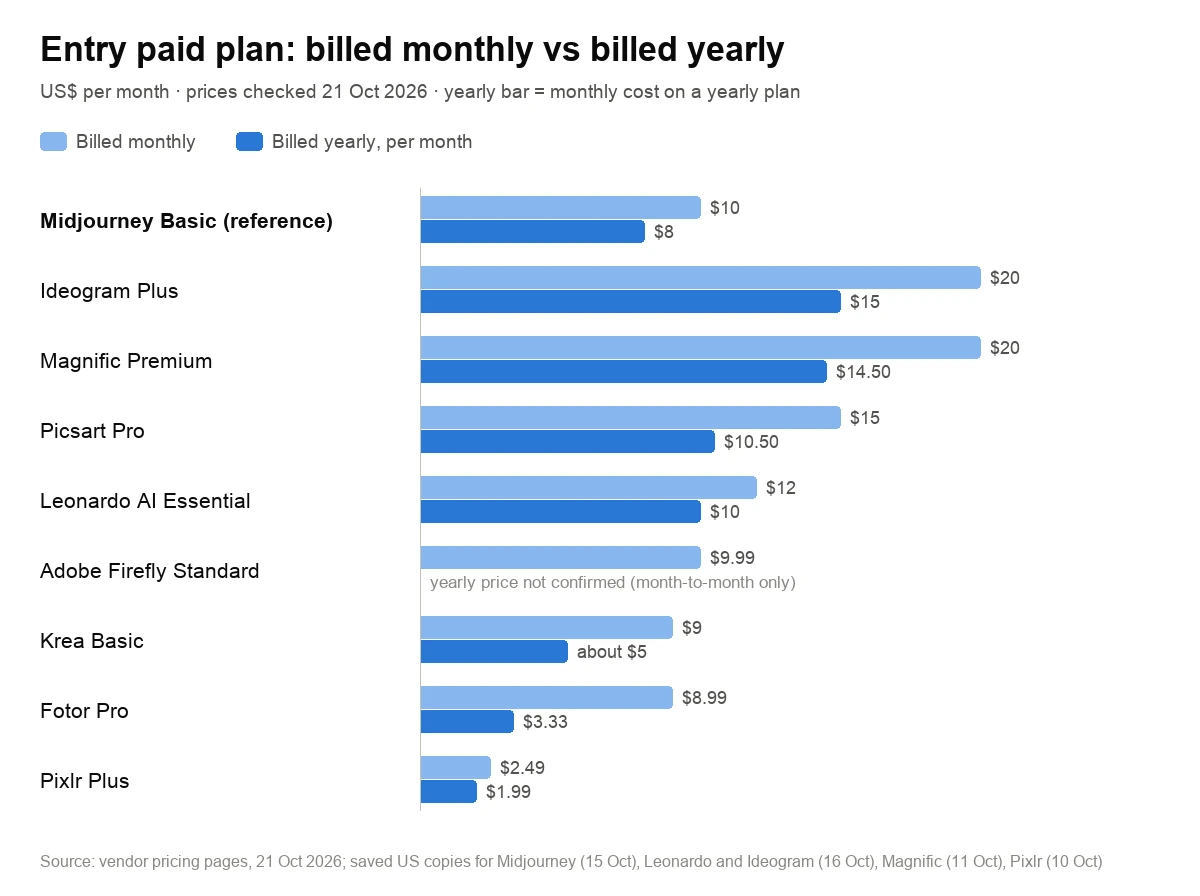
Here is the entry paid plan, the free tier, the commercial terms and the job each Midjourney alternative suits best, with the original in the first row for reference.
Prices checked on 21 October 2026, in US dollars. Where a live page blocked us or showed euros, we used the latest saved US copy: Leonardo and Ideogram from 16 October, Magnific from 11 October, Pixlr from 10 October.
| Tool | From, per month | Free plan | Commercial use | Best for |
|---|---|---|---|---|
| Midjourney | $10, or $8 billed yearly | No trial | Yes; Pro or Mega above $1M revenue | Reference point |
| Leonardo AI | $12, or $10 billed yearly | 150 tokens a day | Yes; Leonardo owns free-plan images | A similar plan ladder with a free tier |
| Krea | $9, or about $5 billed yearly | 100 units a day, no card | Paid plans only | Many models, upscaling to 22K |
| Ideogram | $20, or $15 billed yearly | Weekly credits | Yes; no ownership claimed | Designs with text, print on demand |
| Adobe Firefly | $9.99 | Daily limits | Firefly models: “safe for commercial use” | Brand and client work |
| Magnific | $20, or $14.50 billed yearly | Stock downloads only | Commercial AI license | Stock library plus generators |
| Picsart | $15, or $10.50 billed yearly | 5 credits a week | Yes, without warranties | Editing and generating in one app |
| Fotor | $8.99, or $3.33 billed yearly | Limited credits | Yes, per its help center | Cheap yearly plan, several models |
| Pixlr | $2.49, or $1.99 billed yearly | Free editor | Yes; Pixlr also gets a license | Lowest entry price here |
Model names separate these tools less than you might expect. Krea measures its plans in Nano Banana 2 generations, Picsart and Fotor sell Nano Banana Pro, Leonardo charges tokens for GPT-Image-1 and Nano Banana, and Firefly includes partner models from Google, OpenAI and Flux. Compare limits, rights and privacy first.
Midjourney vs Leonardo AI
In a Leonardo AI vs Midjourney choice, prices line up closely: $10 against $12 at entry, and both put unlimited relaxed image generation on a $30 plan. The real gaps are free use, privacy and ownership.
| Point | Midjourney | Leonardo AI |
|---|---|---|
| Entry plan | Basic: $10, or $8 billed yearly | Essential: $12, or $10 billed yearly |
| Free use | No trial on the website or in Discord | 150 fast tokens a day |
| Unlimited relaxed images | From Standard, $30 | From Premium, $30, selected models |
| Private images | Stealth Mode on Pro and Mega, from $60 | Every paid plan, from $12 |
| Video | Image-to-video; unlimited Relax video on Pro and Mega | Relaxed video on Ultimate ($60); Veo 3, Kling and Sora 2 cost tokens |
| Rights | Any subscriber; Pro or Mega above $1M revenue | Paid: full ownership. Free: Leonardo owns, you get a license |
| Refunds | Only under 20 GPU minutes used | Not stated on the pricing page |
Pick Leonardo AI to try before paying, to keep client images private on a $12 plan, or for team seats at $24 each. Its free tier allows commercial use, but the company owns those images, so subscribe before making work you need to own. Stay with Midjourney if your workflow depends on its V8 models or its Discord server, and budget for Pro if your company earns over $1M a year.
Token allowances and team plans are listed on Leonardo’s pricing page.
Krea AI vs Leonardo AI
Both give a free daily allowance, with different rights. Krea’s free plan offers 100 compute units a day for its in-house Krea 3 model and real-time generation, needs no card and carries no commercial license; the full model list starts with Basic. Leonardo’s gives 150 fast tokens a day and allows commercial use, while the company keeps ownership of those images.
- Entry price: Krea Basic costs $9 a month, or about $5 on yearly billing, and Krea says its 5,000 monthly units cover about 112 Nano Banana 2 images. Leonardo Essential costs $12 for 8,500 tokens.
- Unlimited generation: Krea reserves relaxed generation for Max (from $70 a month, or $42 billed yearly) and for its in-house models; Leonardo starts it at Premium for $30, for selected models.
- Upscaling: paid Krea plans upscale to 22K, including with the Topaz Standard model, while the free plan stops at 2K.
- Models: Krea pairs its in-house Krea 3 with third-party models such as Nano Banana 2 and Seedance; Leonardo charges tokens for outside models such as GPT-Image-1.
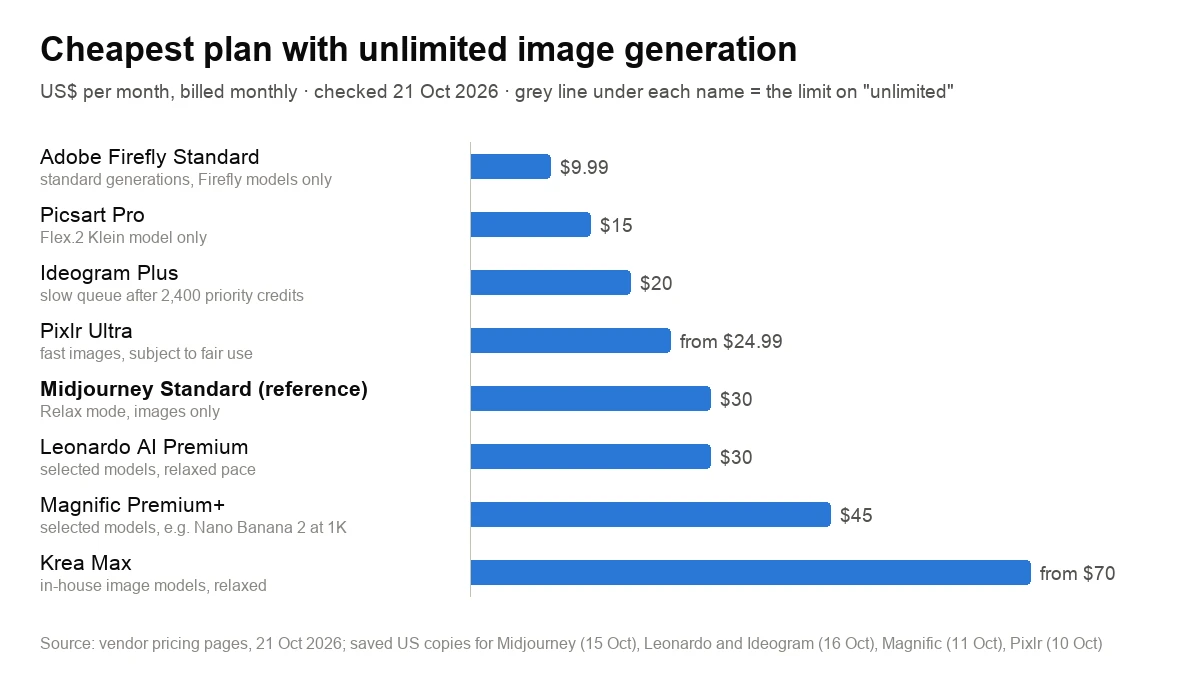
Pick Krea for cheap yearly access to many models and large upscales; pick Leonardo for a free tier you can use commercially and unlimited relaxed images at $30. To sharpen output from either one, see our comparison of AI upscalers.
We may earn a commission if you buy through links on this page.
Ideogram: designs with text and private images from $15
Ideogram’s site lists print on demand and “Editable text layers” among its use cases. On rights, its pricing FAQ is plain: “We do not claim ownership of your generated images, and you’re free to use them for any purpose, including commercial use.”
- Price: Plus costs $20 a month or $180 a year ($15 a month) for 2,400 priority credits; Pro costs $60, or $504 a year, for 7,500. Developers can pay as they go at 1 cent per credit.
- After the credits: Plus and Pro fall back to unlimited slow credits, but editing with AI and image reference still need priority credits.
- Privacy: images are published by default; only Plus and Pro subscribers can create unpublished ones.
- Catch: no free trials on subscriptions, unused priority credits expire each billing cycle, and cards are the only way to pay, with no PayPal.
Eligible free accounts receive weekly credits when they sign in with Google, Apple or Microsoft, and Ideogram notes that “the amount may vary”. Current plans are on Ideogram’s pricing page.
Adobe Firefly: the pick for brand and client work
Adobe’s plans page says: “Outputs from Adobe Firefly AI models are safe for commercial use.” Read the scope closely: IP indemnification covers only select outputs for eligible enterprise customers, and you judge for yourself the output of partner models from Google, OpenAI, Flux and others that Firefly also offers.
- Price: Standard costs $9.99 a month, Pro $19.99, Pro Plus $49.99 and Premium $199.99. Every paid plan includes unlimited standard image generation with Firefly’s own models; the 2,000, 4,000, 10,000 and 50,000 monthly credits cover video, audio and partner models. We saw month-to-month prices only.
- Included apps: every paid plan includes Firefly Boards and Firefly on web and mobile; Pro, Pro Plus and Premium add Photoshop on web and mobile and Adobe Express Premium.
- Video: up to 20 five-second videos on Standard, 40 on Pro and 100 on Pro Plus.
- Trial: Standard, Pro and Pro Plus show a free-trial button; the page doesn’t say how long the trial lasts.
Adobe completed its purchase of Topaz Labs on 23 September 2026, and Topaz technology already works inside Firefly and Photoshop for upscaling.
See Firefly plans and free trials
We may earn a commission if you buy through links on this page.
Editors with a generator inside: Picsart, Fotor, Pixlr and Magnific
All four sell AI image generation inside a wider photo, design or stock service, which suits people who edit and publish in one place.
Picsart
- Price: Pro costs $15 a month or $126 a year ($10.50 a month) for 500 AI credits, plus unlimited images from the Flex.2 Klein model. Ultra, with 200+ models, starts at $47 a month for 1,500 credits.
- Free: 5 AI credits a week and the standard editing tools.
- Rights: you own the output “to the extent allowable by law” and may use it for any legal purpose, but Picsart gives no copyright warranty, and text-to-image results may be public and remixable by default.
- Catch: the web plan data shows zero trial days, while the FAQ says most plans include a trial; the terms call payments nonrefundable, yet the help center accepts refund requests for web purchases.
Until 31 October 2026 (offer seen on 21 October), Pro and Ultra subscribers get unlimited WAN 3.0 generations. Plans, credits and cancelling are covered in our Picsart review.
See Picsart Pro and Ultra prices
We may earn a commission if you buy through links on this page.
Fotor
- Price: Pro costs $8.99 a month or $39.99 a year ($3.33 a month) for 100 credits; Pro+ costs $19.99, or $89.99 a year, for 300. Credits roll over for up to 5 months while you stay subscribed.
- Models: Flux, GPT Image 2, Gemini and Nano Banana Pro.
- Free: the Basic plan is “Free forever” with limited credits; HD and transparent PNG exports need a paid plan.
- Rights: a 2023 help-center article says AI images “can be used for both personal and commercial purposes”. The live article blocked our requests, so we read a copy saved in September 2025.
We may earn a commission if you buy through links on this page.
Pixlr
Pixlr Plus costs $2.49 a month or $1.99 on yearly billing, the lowest entry price in this guide, for 80 AI credits; Pixlr estimates that at about 80 fast AI images. Premium ($9.99, or $7.99 yearly) unlocks every image, video and audio model, 1,000 credits and a private mode for AI generations. Ultra, from $24.99, offers unlimited fast images, “Subject to fair use”.
Its license agreement, updated on 4 June 2026, sums up the rights: “AI outputs can be used commercially, but don’t claim they’re human-made.” Pixlr also takes a perpetual license to your prompts and outputs, and warns that outputs may not be unique. Two more catches: no refunds once a payment is processed, and subscription credits reset to zero when you cancel.
We may earn a commission if you buy through links on this page.
Magnific (formerly Freepik)
Freepik now trades as Magnific. Premium costs $20 a month, or $14.50 billed yearly, for 240,000 credits a year, a commercial AI license, the stock library and its own image and video upscalers. Premium+ ($45, or $33.75) adds unlimited generations with selected models, such as Nano Banana 2 at 1K and Kling 2.5, and the Topaz upscaler. Credits last a year with no monthly resets, and Magnific says it does no model training on your data.
It also advertises a “30-day refund guarantee” and no cancellation fees. Its free plan covers stock downloads, 10 a day, with no free AI allowance listed; Magnific’s pricing page shows the current offer.
If you mostly retouch photos rather than generate them, our Luminar Neo review covers a desktop editor sold as a one-time purchase.
Free Midjourney alternatives: what each free plan allows
Free plans are hard to compare by size, since each counts in its own units. Rights differ more clearly, so check who owns an image and who can see it before you publish.
| Free option | What you get | Commercial use | Who can see images |
|---|---|---|---|
| Leonardo AI | 150 fast tokens a day | Allowed; Leonardo owns the images | Public |
| Krea | 100 units a day, Krea 3 and real-time models, no card | Not licensed | Not stated |
| Ideogram | Weekly credits; the amount varies | Allowed; no ownership claimed | Published by default |
| Adobe Firefly | Daily limits; numbers not published | Firefly models: “safe for commercial use” | Not stated |
| Picsart | 5 AI credits a week | Any legal purpose, no warranty | May be public and remixable |
| Fotor | Basic plan with limited credits | Allowed, per a 2023 help article | Not stated |
| Recraft | Allowance not in the page text | Not licensed; Recraft owns the images | Public community gallery |
| niji·journey app | Limited trial, per Midjourney’s help center | Not stated | Not stated |
Recraft, a generator of vector art, icons and illustrations, keeps paid-plan images private, but its prices load only in a browser script, so we left it out of the main table.
Two more options cost nothing extra if you already use them. ChatGPT lists image generation as “Limited” on its free plan and includes it in Go ($8 a month) and Plus ($20), and the free Gemini plan includes image generation and editing.
Self-hosting is the other route. Stability AI’s license page says use of its core models “is free for everyone” unless you or your organization earn over $1M a year and use them commercially; its Community License covers the Stable Diffusion 3.5 suite.
How we picked and checked
We started from Google’s US results for “midjourney alternatives” on 21 October 2026: a review blog, Reddit, vendor lists, YouTube, Quora and a 2025 DigitalOcean guide. We kept image generators with public prices and a paid plan suited to creative or business work.
On 21 October 2026 we read each vendor’s pricing page, terms and help articles, plus Trustpilot for Midjourney. Where a page blocked automated requests (the Midjourney help center, Leonardo, Ideogram, Fotor’s help center), we used copies saved by the Internet Archive and gave their dates. We didn’t buy these plans, so this guide has no image-quality scores and no screenshots from paid accounts; see our testing methods.
We may earn commissions through the Krea, Adobe, Picsart, Fotor and Pixlr links. We earn nothing from Midjourney or Leonardo: we found no affiliate program for the first, and the second closed its program on 7 April 2026.
Main sources: the Midjourney plan comparison, free-trial note, refund rules, terms and changelog. Pricing pages: Leonardo, Krea, Ideogram, Adobe Firefly, Magnific, Picsart, Fotor, Pixlr and Recraft. Rights: Picsart’s generative AI terms, Fotor’s help article, Pixlr’s license agreement and Stability AI’s license page. Lawsuits: NBC News, Reuters via The Star and TechCrunch.
FAQ
Basic costs $10 a month, Standard $30, Pro $60 and Mega $120. Paying for a year cuts that by 20%, to $8, $24, $48 and $96 a month, charged upfront. Basic includes 200 minutes of fast GPU time and no unlimited Relax mode, and Stealth Mode, which keeps images private, starts at Pro. Extra fast time costs $4 an hour.
Not on its website or in Discord. Its help center says a limited trial exists only in the niji·journey app for iOS and Android. Refunds are possible only if your account has used under 20 GPU minutes in its lifetime. To try before paying, use a free tier elsewhere: Leonardo gives 150 tokens a day and Krea 100 units a day.
We didn’t score image quality, so we can’t rank the pictures. On terms, Leonardo is easier to start with: a free tier, private images from $12 and full ownership on paid plans. Midjourney’s Stealth privacy starts at $60, and a company earning over $1M a year must buy Pro or Mega there; Leonardo’s pricing page mentions no revenue cap.
For commercial use, Ideogram: free accounts get weekly credits, and the company claims no ownership of generated images, though they are published by default. Leonardo’s 150 daily tokens allow commercial use, but the company owns those images. Krea’s 100 daily units cover its in-house Krea 3 model, without a commercial license. Fotor’s Basic plan stays free with limited credits.
Usually, on a paid plan. Midjourney allows commercial use for any subscriber, with Pro or Mega required above $1M in revenue. Leonardo and Recraft give full ownership on paid plans, and Krea a commercial license from Basic; Krea and Recraft exclude free-plan images. Adobe calls Firefly-model output “safe for commercial use”, and Picsart allows any legal use without a copyright warranty.
Leonardo makes generations private on every paid plan, from $12 a month. Ideogram lets Plus and Pro subscribers create unpublished images, from $15 a month billed yearly. Recraft keeps paid-plan images out of its community gallery, and Pixlr Premium has a private mode. Midjourney’s Stealth Mode starts at $60, and images made in shared Discord rooms stay visible there.