
Grok vs ChatGPT in 2026: plans, limits, real-time data and what each does badly
We may earn a commission if you buy through links on this page, at no extra cost to you. The page has one ElevenLabs link, in the voice section. As an independent ElevenLabs affiliate, we may earn a commission if you subscribe through this link.
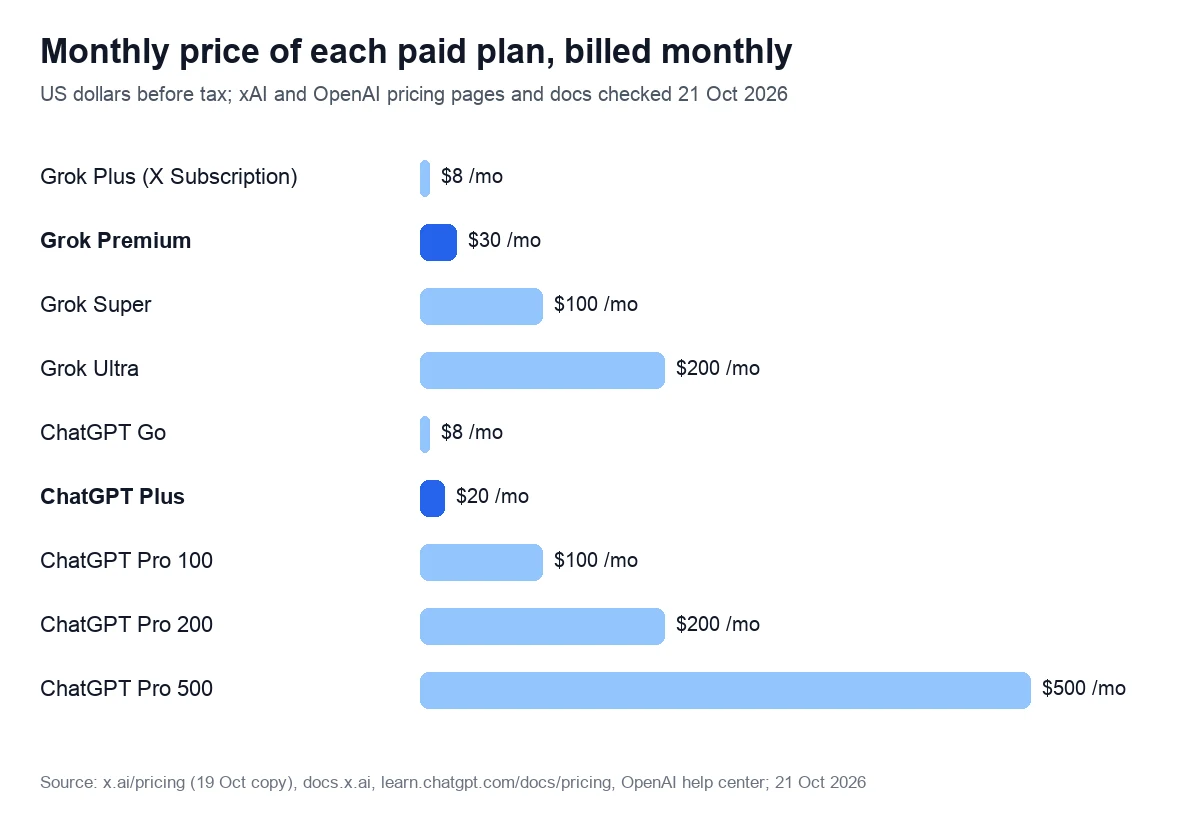
This Grok vs ChatGPT comparison for 2026 starts with price. xAI’s paid plans run from $8 to $200 a month and OpenAI’s from $8 to $500. xAI’s “Most popular” Premium costs $30, OpenAI’s Plus $20 (checked 21 October 2026).
Short answer. For coding, research reports and images, ChatGPT Plus is the safer $20: public leaderboards rank OpenAI’s models above xAI’s. Grok Premium suits people who post on X, want video generation and Cursor in one bill, or prefer yearly billing. Neither plan page lists brand tracking in AI answers, licensed voiceovers or avatar videos; tools that do are below.
Plans and prices in October 2026
On 12 October 2026, xAI, now owned by SpaceX, launched The X Subscription: one plan for Grok, the Cursor coding app and X. New customers start on it. OpenAI’s prices haven’t changed since 7 October.
Grok plans: The X Subscription
Prices checked on 21 October 2026 in xAI’s subscription docs, in US dollars before tax; plan wording is from its plans page (19 October copy).
| Plan | Monthly | Billed yearly | Usage, in xAI’s words |
|---|---|---|---|
| Free | $0 | — | “Limited Chat requests” |
| Plus | $8 | $80 ($7 a month) | “Shared AI usage pool”; for “social creators with limited AI usage” |
| Premium | $30 | $300 ($25 a month) | “4x more usage compared to Plus” |
| Super | $100 | $1,000 ($84 a month) | 15x Plus, priority at peak times |
| Ultra | $200 | $2,000 ($167 a month) | 50x Plus |
| Teams | From $30 a seat | — | Premium, Super or Ultra seats; no Plus |
ChatGPT plans: Free to Pro 500
Prices checked on 21 October 2026 in OpenAI’s plan docs; plan wording is from its pricing page (19 October copy). EU visitors see euro prices.
| Plan | Monthly | Billed yearly | Usage, in OpenAI’s words |
|---|---|---|---|
| Free | $0 | — | “Unlimited text chats with GPT-6”, within abuse guardrails |
| Go | $8 | Not offered | “More messages with tools”; “may include ads” |
| Plus | $20 | Not offered | “Limits apply” |
| Pro 100, 200, 500 | $100, $200 or $500 | Not offered | “Your choice of 3 usage tiers” |
| Business | $25 a seat | $20 a seat a month | From 2 users |
Against Plus, xAI’s Premium costs $10 a month more, or $5 more if you prepay a year: $300 works out to $25 a month. OpenAI does “not support annual billing” for Go, Plus or Pro. The US App Store also lists a second “ChatGPT Plus” item at $200.00, with no billing period shown.
Older plans keep running: existing SuperGrok, Cursor and X Premium plans “continue unless you change or cancel them”. X Premium+, $40 a month on X’s help page (10 October copy), included SuperGrok; those X perks now come with Premium and up.
Usage limits and context windows
Neither vendor publishes a message count for its $20–$30 plan. xAI sizes plans in multiples of Plus. OpenAI’s pricing table marks everyday text chats “Unlimited*” on every plan, for “reasonable” use, while the Plus card adds “Limits apply” (19 October copy).
| Rule | xAI, The X Subscription | OpenAI |
|---|---|---|
| How limits are stated | Multiples: Premium 4x Plus, Super 15x, Ultra 50x | Everyday text chats “Unlimited*” on all plans; Plus card: “Limits apply”; caps “may vary based on system conditions” |
| What shares one allowance | Chat, Imagine, Voice, Build, Bot and Cursor, refreshed weekly | Codex and Work: 5-hour and weekly windows |
| When it runs out | Paid features pause until the weekly reset | Codex and Work draw on credits you buy |
| Paying past the cap | Top-ups from $5, dearer than plan usage | 100 credits for $4 in the App Store |
| Context window | 500K tokens for Grok 4.7 in the API; none listed for the app | Plus: 54K Instant, 256K reasoning; Pro: 128K and 400K |
xAI says a weekly pool means “one heavy day never wipes out your whole month”. The catch is that everything draws on it: “A chat message uses little compute; generating a high-quality video or running a long coding task uses far more”. Once it’s spent, only the free tier’s chat and voice limits remain until the reset.
OpenAI’s help center says Plus “may include usage limits such as message caps, especially during high demand”. Pro isn’t unlimited either: “A Pro subscription does not include unlimited use of the GPT-6 Pro model”. What the $100, $200 and $500 tiers add is in our ChatGPT Plus vs Pro guide.
For coding: Codex vs Grok Build and Cursor
Every OpenAI plan includes Codex, from “Limited Codex access” on Free to “Expanded Codex usage” on Plus, where OpenAI estimates 5–45 local messages per five hours with GPT-6 Astra. The Pro tiers have no five-hour limit in Codex and ChatGPT Work for now, though their allowance is still finite.
Each paid xAI seat includes Cursor and Grok Build, which share the weekly pool with chat. xAI’s newest model, Grok 4.7, launched on 21 September 2026 in Cursor and Build. Claude or GPT models inside Cursor aren’t covered by the plan: they’re “billed at API list prices from the first use”.
Rankings favour OpenAI. On Agent Arena’s coding board (8 October 2026; 773,095 sessions), GPT 6.1 Sol (Max) is 2nd, GPT 6 Astra (Max) 4th and Grok 4.7 (xHigh) 17th; Claude Opus 5.5 is 1st. xAI’s launch table puts Grok 4.7 ahead on CursorBench 4.0, 46.3% to 41.7%; on DeepSWE, the same table has GPT-5.6 Sol ahead, 72.7% to 71.0%. Both figures are vendor data, measured against an earlier OpenAI model.
Per token, xAI is cheaper: the same table lists its model at $2 per million input tokens and $6 per million output, against $4 and $20 for GPT-5.6 Sol. Per task, it isn’t. Artificial Analysis measured $3.74 per index task for Grok 4.7 against $0.72 for GPT-6.1 Sol, and found it “very verbose”: 240 million output tokens against a median of 82 million.
For writing: rankings, projects and saved assistants
We didn’t run writing tests. The closest public signal is LMArena’s text board, ranked by 8.6 million votes (board of 2 October 2026). OpenAI’s best entries rank 20th and 21st, at 1484 and 1483. xAI’s best, grok-4.20-beta1, is 36th at 1475, and grok-4.7-xhigh is 91st. Google’s gemini-4-argon-high leads at 1525 (preliminary).
Plus includes projects and scheduled tasks, but personal plans can no longer create new custom GPTs, and on 11 September 2026 OpenAI announced plans to retire them. xAI’s app offers to “transfer your conversations and context” from other assistants, and Premium and up include X Premium+ perks for people who publish on X.
When chat limits get in the way of a content plan. With possible message caps on Plus “during high demand” and a weekly pool at xAI, a monthly article target is hard to plan. Content tools state quotas instead. Frase Starter includes 10 articles and 50 audit pages a month for $49, or $39 a month billed yearly, and “simply stops at its monthly limits”, so there’s no surprise bill.
It comes with a 7-day free trial and no card (checked 21 October 2026); our Frase review has the details.
Start Frase’s 7-day free trial
We may earn a commission if you buy through this link. It does not change the price you pay.
For research: real-time data, sources and accuracy
Real-time data is xAI’s pitch. Its App Store listing promises “direct access to X and the web” and “advanced searches on X”. OpenAI’s Search, included on Free, looks up “current or niche information from the web” and answers with citations.
Freshness depends on search: xAI’s API docs say its models have “no knowledge of current events” without the Web Search or X Search tool, and OpenAI says the same of answers without search. With search on, LMArena’s Search Arena (24 August 2026; 1.11 million votes), which tests models through their APIs rather than the apps, ranks gpt-5.6-sol-xhigh 1st at 1257 and grok-4.5 8th at 1213.
For long reports, OpenAI’s deep research is “Limited” on Free and Go, expanded on Plus and “Maximum” on Pro; quotas aren’t published, and reports download as Markdown, Word or PDF. xAI’s listing promises “deep research on the web”, and its FAQ allows about 100 files per upload on the web, up to 150 MB each. If cited search is the main job, also see our Perplexity vs ChatGPT comparison.
Neither vendor vouches for the answers. OpenAI lists “Fabricated quotes, studies, citations or references to non-existent sources” among possible errors and advises: “Use ChatGPT as a first draft, not a final source”. xAI’s privacy policy says it “cannot guarantee the factual accuracy” of model output.
What neither shows you: whether AI answers mention your brand. If you sell something, the question is whether these assistants recommend you, and neither plan page offers a way to track it. AI visibility trackers do:
- SE Ranking reads answers from ChatGPT, Gemini, AI Mode and AI Overviews. Core costs $129 a month, or $103.20 a month billed yearly, for 100 prompts tracked daily, after a 14-day trial without a card: our SE Ranking review.
- Mangools AI Search Watcher is the only one of these three that lists Grok on a self-serve plan, next to ChatGPT, Gemini and Claude. Its SEO + AI Basic plan checks 500 prompts weekly for $61 a month, or $37.70 a month billed yearly (US-dollar list, 17 October copy): AI Search Watcher, our review.
- Writesonic’s Starter tracks 50 prompts daily across ChatGPT, Gemini and Google AI Overviews, with 15 AI articles a month, for $79 a month billed yearly; Grok isn’t on its self-serve plans. Writesonic, our review.
Try SE Ranking’s AI tracker free for 14 days
We may earn a commission if you buy through links on this page.
Prices checked on 21 October 2026. More trackers are compared in our guide to AI visibility tools.
Images, video and voice
Images
On LMArena’s text-to-image board (7 October 2026; 6.6 million votes), OpenAI’s gpt-image-2.5-sunburst is first at 1425 and xAI’s grok-imagine-image-2.0 (canvas) fourth at 1334, both preliminary. xAI watermarks every image and video, with “no setting to remove” it.
Video
OpenAI shut the Sora app and website on 26 April 2026 and the Sora API on 24 September; its pricing table mentions video only as “Voice with video”. xAI’s Imagine makes “short videos with sound” from text or photos, out of the same weekly pool, and 720p clips “fall back to 480p” once you hit your tier’s cap.
Turning an answer into a presenter video. For a training clip or explainer with a speaking presenter, neither plan page lists avatars, and xAI’s clips are watermarked.
Synthesia’s free Basic plan gives 10 minutes of video a month with a watermark. Starter costs $19 a month for US visitors, or $14 a month billed yearly; the standard price list shows $29 and $18 a month (checked 21 October 2026). Since 23 September, Synthesia’s MCP connector can create videos from inside ChatGPT and Claude.
See Synthesia’s plans and free tier
We may earn a commission if you buy through links on this page.
Prices and plans are in our Synthesia review; for other presenters and voices, see our guide to AI avatar generators.
Voice
OpenAI caps GPT-Live voice at 3 hours a day on Go and Plus and 15 on Pro $100, with no cap on Pro $200. xAI’s voice mode draws on the weekly pool, and its API sells text-to-speech at $15 per million characters.
Turning text into a voiceover you can publish. Outside xAI’s API, both voice modes are built for talking to the assistant. Narration for a video, course or podcast needs an audio file and a commercial license, which voice generators state plan by plan.
ElevenLabs Starter costs $6 a month and includes a commercial license, instant voice cloning and about 30 minutes of speech. The free plan’s 10,000 credits, about 10 minutes, carry no commercial license (checked 21 October 2026).
As an independent ElevenLabs affiliate, we may earn a commission if you subscribe through this link.
Murf’s free plan gives 10 minutes without downloads or commercial rights (7 October). Creator costs $29 a month for 2 hours, or $228 a year for 24 hours, with both. Try Murf free, or read our ElevenLabs vs Murf comparison.
We may earn a commission if you buy through this link. It does not change the price you pay.
Grok vs ChatGPT vs Gemini: where Google fits
Google’s figures come from our 7 October 2026 check for Gemini vs Claude; the other two columns are from 21 October.
| Item | xAI | OpenAI | |
|---|---|---|---|
| Cheapest paid plan | Plus, $8 | Go, $8 | AI Plus, $4.99 |
| The $20–$30 tier | Premium, $30 | Plus, $20 | AI Pro, $19.99 |
| Top individual plan | Ultra, $200 | Pro 500, $500 | AI Ultra 20x, $199.99 |
| Yearly billing | Yes, priced at 10 months | No | No yearly price listed |
| Video generation | Yes, watermarked | No, since Sora closed | Included in AI Pro |
| Context on the $20–$30 tier | Not published for the app | 54K Instant, 256K reasoning | 1 million tokens |
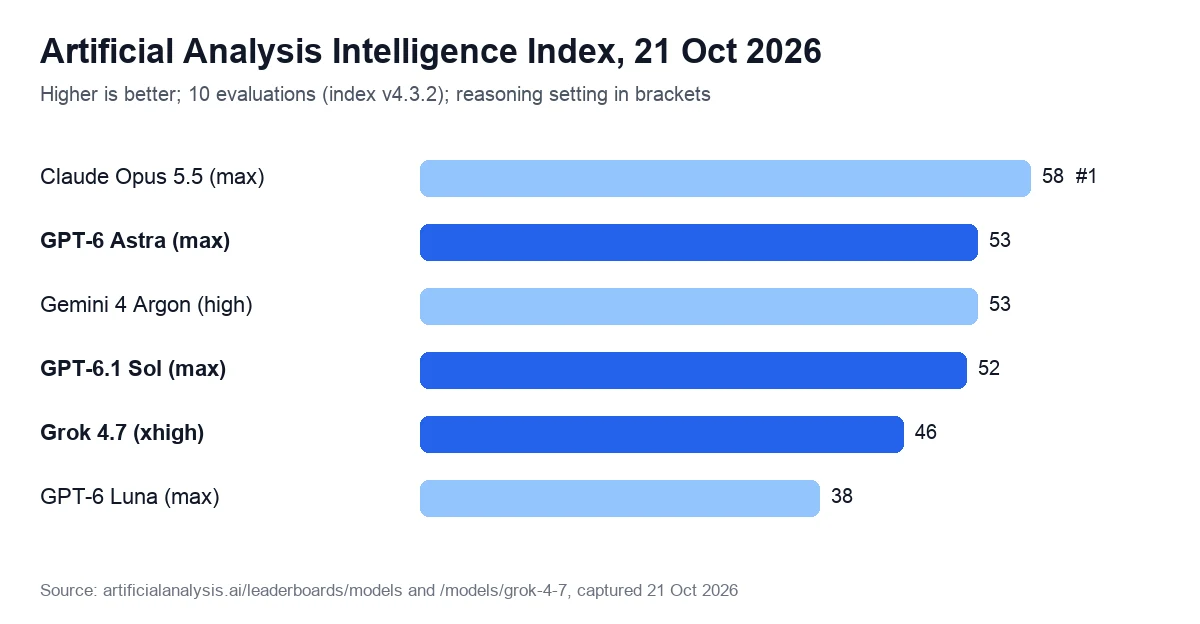
| Best model, Artificial Analysis index | 46 | 53 | 53 |
Google is cheapest at the bottom and ties OpenAI on the Artificial Analysis index, at 53.
Privacy, ads, refunds and billing traps
Both may use consumer chats to train models. At xAI, its docs describe an “improve the model” toggle in Data Controls on grok.com and in the apps. At OpenAI, the switch is “Improve the model for everyone” in Settings, Data controls, marked “Opt-out available” on Free, Go, Plus and Pro. xAI deletes Private Chat conversations within 30 days.
OpenAI began testing ads in the US on 9 February 2026. They “may appear” on Free and Go, not on Plus or Pro, and OpenAI says ads “do not influence” answers.
Refunds are narrow at both; the rules are in the FAQ below. Watch for these billing traps:
- Moving an older SuperGrok, Cursor or X Premium plan to The X Subscription is permanent: it “can’t be undone, and Support can’t undo it for you”.
- A Cursor plan billed through Apple survives the switch; cancel it in iPhone settings, “or Apple keeps billing you”.
- xAI’s FAQ says large unexpected invoices “are often a SuperGrok Heavy yearly subscription, not API usage”.
- Pro 200 subscribers active between 22 and 29 September keep the old allowance only until 29 October 2026; new sign-ups get “a lower usage allowance” for the same $200.
- Most promotional Plus offers “auto-renew to the standard ChatGPT Plus monthly rate”; cancel at least 24 hours before renewal.
US App Store, 21 October 2026: the Grok app has 4.9 stars from 1.5 million ratings and is rated 16+; ChatGPT has 4.8 from 11 million and is rated 13+.
Which one to pick, and when to add another tool
- OpenAI’s Plus, $20: for Codex, cited research reports you can export to Word or PDF, and images. Not for video generation, which OpenAI dropped with Sora.
- xAI’s Premium, $30 or $25 a month yearly: for people who post on X, want video with a watermark, or want Cursor bundled. Not where benchmark rank matters: xAI trails on every public leaderboard cited here.
- Super or Pro 100, $100: only for a known heavy load, since neither publishes a message count.
- Neither, on its own: for brand tracking in AI answers, licensed voiceovers or avatar presenter videos, add one of the tools above.
How we compared, and what we didn’t
On 21 October 2026 we read xAI’s and OpenAI’s pricing pages, help centers, docs, terms and app-store listings, logging each figure with a quote, link and date. Pages that blocked our requests came from archived copies made between 29 September and 21 October; Google’s figures are from 7 October.
We didn’t run prompts, time answers or score them. Rankings come from LMArena, Agent Arena and Artificial Analysis, each dated; xAI’s own benchmark table is labelled as vendor data. xAI and OpenAI don’t pay us, and we have no affiliate links to either. Links to the content, tracking, video and voice tools may earn us a commission.
Not covered: business plans in depth, API rate limits, regional availability and answer quality on your own prompts. More on our process: how we test and our editorial transparency policy.
FAQ
On public leaderboards, no. On 21 October 2026, Artificial Analysis scored GPT-6 Astra 53 and Grok 4.7 46, and LMArena’s text, search and image boards also rank OpenAI’s best entries above xAI’s. xAI’s plans do bundle things OpenAI’s don’t: video generation, X Premium+ perks and Cursor in one bill.
Yes, within limits. xAI’s Free plan lists “Limited Chat requests” and “Limited agent requests” at $0, and paid users fall back to the free tier’s chat and voice limits once their weekly pool runs out. The shared weekly pool, Cursor and Grok API access start with Plus at $8 a month, or $80 a year; API calls are billed separately.
Since 12 October 2026, xAI says new customers “start on The X Subscription”. Its Premium plan, also $30 a month, carries the old SuperGrok features: Grok Bot, the latest models, and image and video generation. Existing SuperGrok plans continue, and on 21 October the US App Store still listed SuperGrok at $30.00 and SuperGrok Heavy at $300.00, without a billing period.
It can. xAI’s privacy policy, in a 19 October 2026 copy, lists using content “to train our models”. Its docs describe an “improve the model” toggle in Data Controls on grok.com and in the apps, and Private Chat conversations are deleted within 30 days. API inputs and outputs aren’t used for training without explicit permission.
Not anymore. OpenAI discontinued the Sora app and website on 26 April 2026 and the Sora API on 24 September 2026, and its pricing table mentions video only as “Voice with video”. xAI’s Imagine still makes short videos with sound, watermarked. For presenter videos, Synthesia’s MCP connector can create them from inside ChatGPT.
Rarely. OpenAI calls payments “generally non-refundable” but may refund an unused subscription if you ask within seven days of the charge; in the EU, UK and Turkey, cancelling within 14 days brings a prorated refund. xAI’s terms make payments “non-refundable, except where required by law”, though it takes refund requests for web and Google Play purchases. Apple handles App Store refunds for both.